

When we think about plants, we imagine them standing quietly in the sun, making their own food through photosynthesis. And that’s true for most plants! But nature always has surprises. Some plants don’t just sit and wait — they trap and eat insects. These amazing plants are called carnivorous plants.
The word carnivorous means “meat-eating.” But don’t worry — these plants don’t eat big animals. They mostly catch insects, spiders, and tiny water creatures.
You might wonder — if plants can make their own food, why do they need to eat insects?
Carnivorous plants usually grow in places where the soil is very poor in nutrients, especially nitrogen, which plants need to grow strong and green. These places include:
Swamps
Marshes
Bogs
Wetlands
Because the soil does not give them enough nutrients, these clever plants developed special ways to catch insects and digest them. The insects provide the extra nutrients they need to survive.
Even though they eat insects, they still make food using sunlight like other plants.
Different Types of Traps
Carnivorous plants use different kinds of traps. Each one is specially designed!
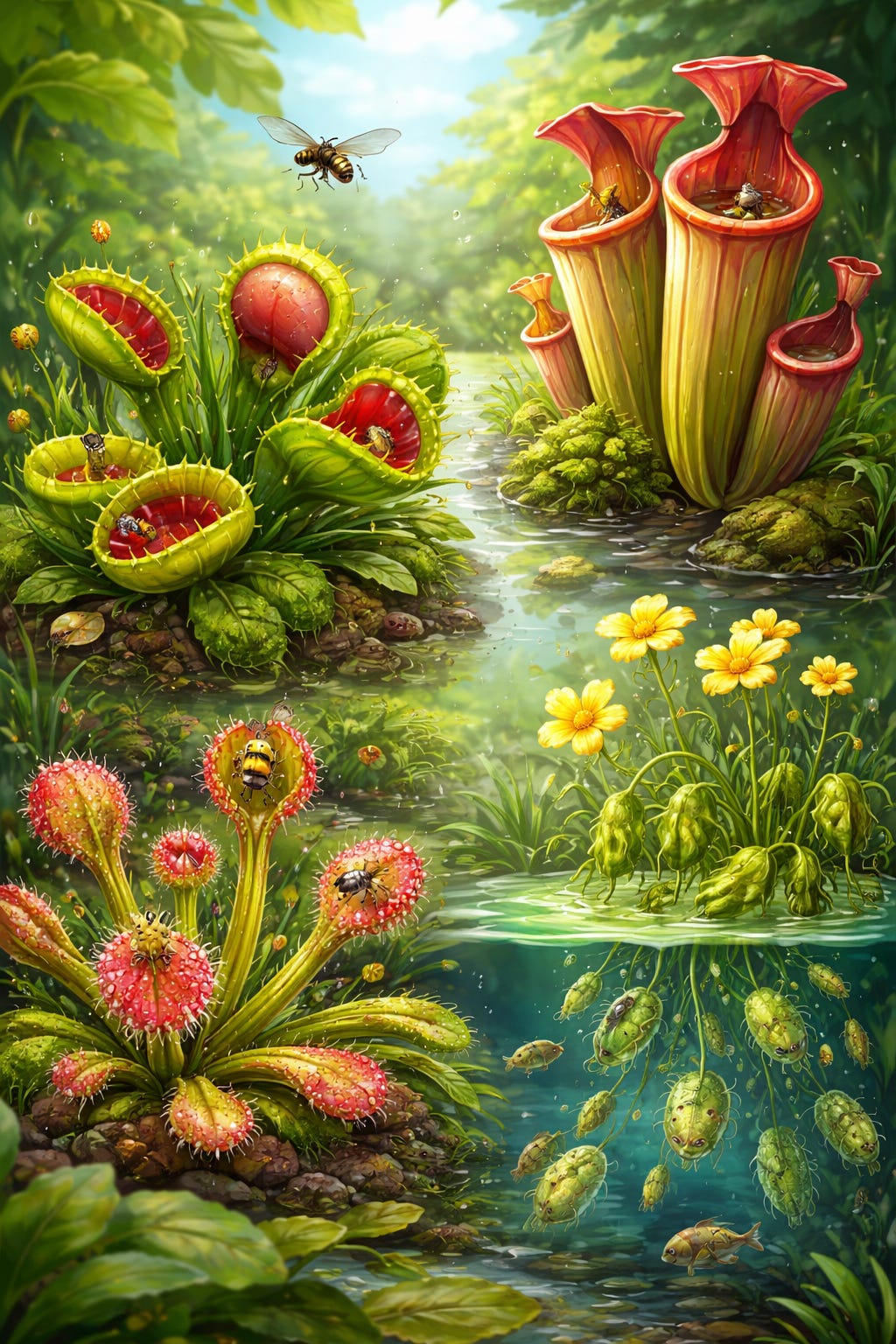
Snap Trap – Venus flytrap
The Venus flytrap is the most famous carnivorous plant. It has leaf parts that look like tiny jaws with spiky edges.
Inside the trap are tiny sensitive hairs. When an insect touches these hairs more than once, the trap quickly snaps shut in less than a second!
The plant then releases digestive juices and slowly breaks down the insect. After a few days, the trap opens again, ready for its next meal.
Amazing fact: The Venus flytrap can actually “count” touches before closing!
Pitfall Trap – Pitcher plant
Pitcher plants have leaves shaped like deep tubes or cups called pitchers. These pitchers contain sweet nectar that attracts insects.
When insects land on the rim, they slip and fall inside. The inside walls are very slippery, so they cannot climb out. At the bottom is a liquid that digests the insect.
Some tropical pitcher plants are so large that they can trap frogs or small rodents!
Sticky Trap – Sundew
Sundews have leaves covered in tiny red tentacles with shiny sticky drops at the tips. These drops look like sparkling dew in sunlight.
When an insect lands on the leaf, it gets stuck in the sticky liquid. The tentacles slowly bend inward and wrap around the insect. Then the plant digests it.
It’s like natural sticky glue!
Suction Trap – Bladderwort
Bladderwort is different because it lives in water. It has tiny bladder-like sacs underwater.
When a small water insect touches the trigger hairs, the bladder opens and sucks the insect in within milliseconds! It is one of the fastest traps in the plant world.
Carnivorous plants grow all around the world, including: North and South America, Africa, Australia, Asia. They mostly grow in warm, wet areas with poor soil.
How Do They Digest Their Food?
After trapping their prey, carnivorous plants release special digestive enzymes. These enzymes break down the insect’s body into simple nutrients. The plant absorbs these nutrients through its leaves.
It’s similar to how our stomach digests food — but much slower!
Carnivorous plants show us how creative and adaptable nature can be. When life gave them poor soil, they found a smart solution — they became hunters!
They may look scary, but they are simply fascinating examples of how plants survive in difficult environments.