

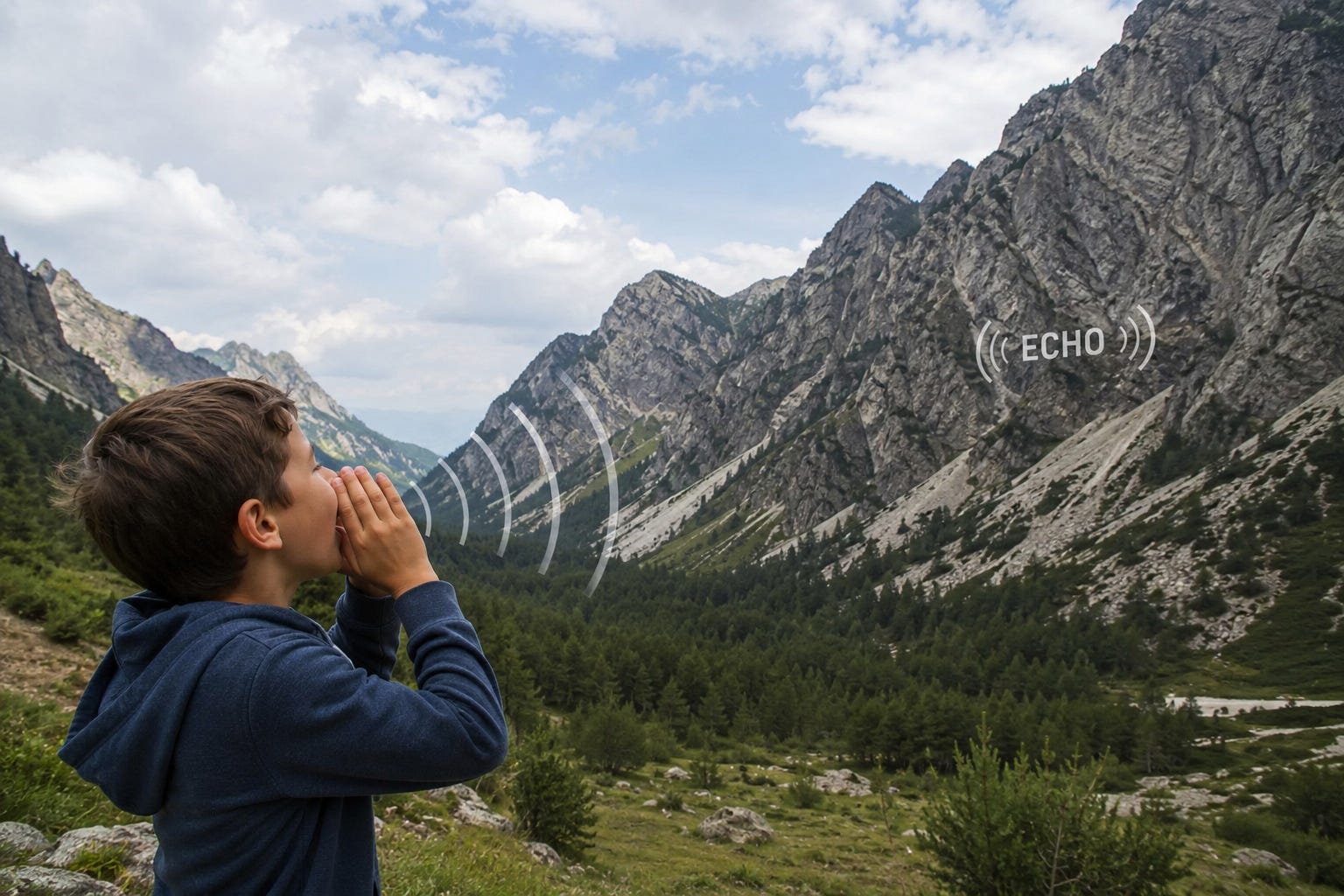
Have you ever shouted your name in a large empty hall, a canyon, or near a mountain and heard it come back to you? That amazing sound is called an echo!
What Is an Echo?
An echo is a sound that bounces off a surface and returns to your ears after a short delay. It is simply your original sound coming back to you.
Think of it like throwing a ball against a wall. The ball bounces back to you. Sound waves can do the same thing!
How Does an Echo Happen?
When you make a sound, it travels through the air as sound waves.
You create a sound by speaking, shouting, or clapping.
The sound waves travel through the air.
They hit a hard surface such as a wall, mountain, cliff, or building.
The sound waves bounce back toward you.
Your ears hear the reflected sound as an echo.
Where Can You Hear Echoes?
Echoes are easier to hear in places with large, hard surfaces.
Some common places include:
Mountains, Canyons, Empty halls, Large tunnels, Caves, Near tall buildings
Soft materials like carpets, curtains, and cushions absorb sound, making echoes harder to hear.
Why Don’t We Hear Echoes Everywhere?
For an echo to be heard clearly, the reflected sound must take enough time to return to your ears. If the surface is too close, the reflected sound mixes with the original sound, and you cannot distinguish it as a separate echo.
That’s why echoes are easier to hear in large open spaces.
Animals That Use Echoes
Some animals use echoes to help them find their way and locate food.
Bats
Bats send out high-pitched sounds and listen to the echoes that bounce back from objects and insects.
Dolphins
Dolphins use a similar method underwater to navigate and find fish.
This process is called echolocation.
Fun Echo Experiment
Try this simple activity:
Find a large empty area or a wall far away.
Clap your hands loudly or shout a short word.
Listen carefully.
You may hear the sound return as an echo!
Always make sure you are in a safe place when trying this experiment.
Amazing Echo Facts
Echoes travel at the speed of sound.
Bats and dolphins use echoes to “see” their surroundings.
Some caves produce very strong echoes.
Scientists use sound echoes in technologies such as sonar and medical ultrasound.
Echoes show us that sound can travel, bounce, and return just like a ball. The next time you hear your voice come back to you, remember that you’re listening to sound waves reflecting from a distant surface. Echoes help us understand the fascinating world of sound and even inspire technologies that scientists use today.