

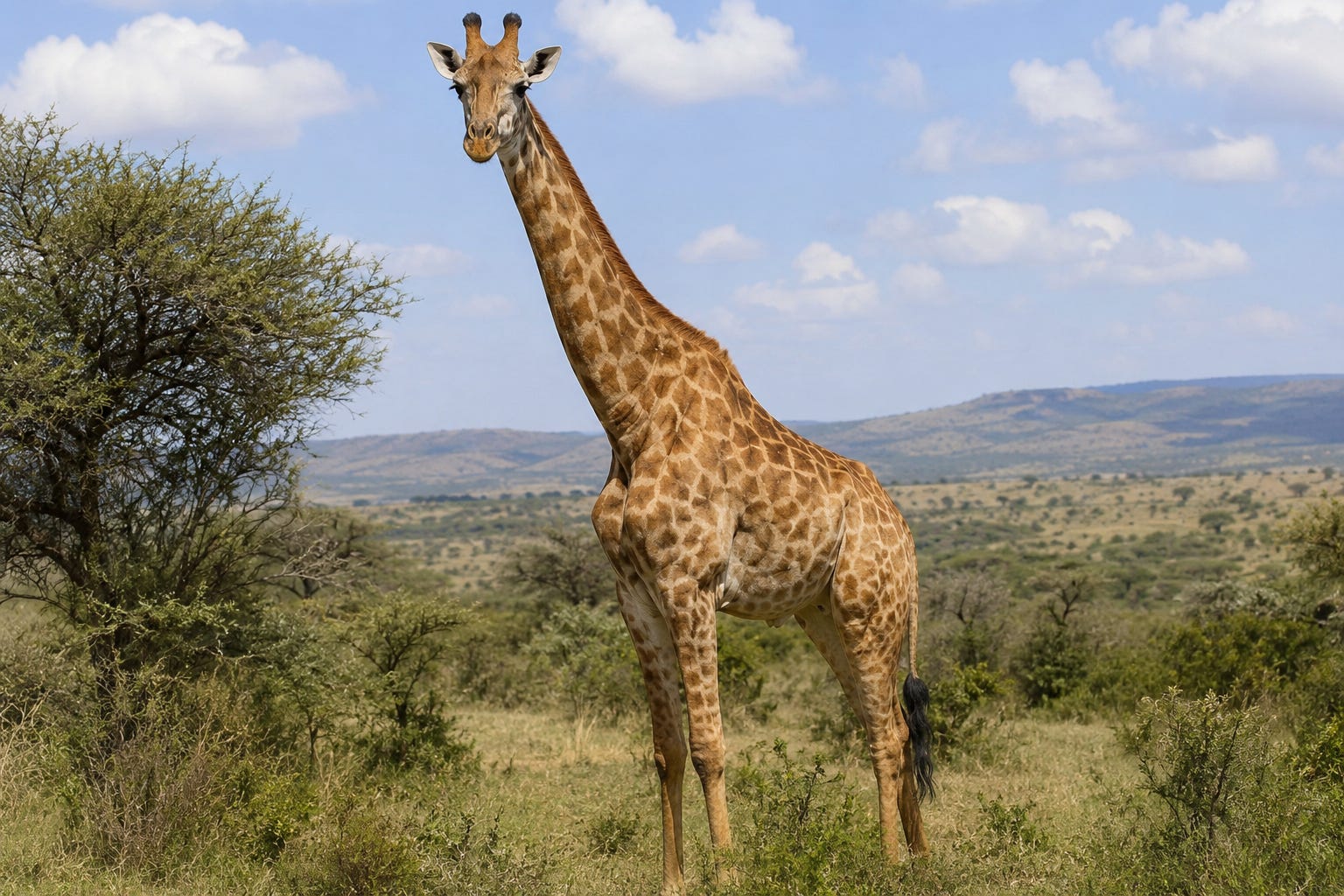
Have you ever wondered what it would be like to look over the tops of trees? A giraffe can do that every day! Giraffes are the tallest land animals on Earth. With their incredibly long necks, long legs, and beautiful spotted coats, they are one of the most fascinating animals in the wild.
These gentle giants live in Africa, where they spend most of their day eating leaves from tall trees. Although they look unusual, every part of a giraffe’s body helps it survive in nature.
Let’s discover some amazing facts about these incredible animals!
A giraffe is a large plant-eating mammal that belongs to the same family as the okapi. It is famous for its extremely long neck, which allows it to reach leaves that other animals cannot.
Despite having such a long neck, a giraffe has only seven neck bones—the same number as humans! The difference is that each bone can be over 25 centimeters (10 inches) long.
Where Do Giraffes Live?
Giraffes live in the grasslands, savannas, and open woodlands of Africa. They are found in countries such as Kenya, Tanzania, South Africa, Namibia, Botswana, and Zimbabwe.
These habitats have plenty of tall trees, especially acacia trees, which provide their favorite food.
What Do Giraffes Eat?
Giraffes are herbivores, meaning they eat only plants.
Their favorite foods include:
Acacia leaves
Young shoots
Flowers
Fruits
Twigs
A giraffe uses its 45–50 cm (18–20 inch) long, dark-colored tongue to grab leaves from thorny branches without getting hurt.
An adult giraffe can eat around 30–35 kilograms (65–77 pounds) of leaves every day.
How Tall Is a Giraffe?
Giraffes are the tallest land animals in the world.
Adult males can grow up to 5.5–6 meters (18–20 feet) tall.
Adult females usually grow up to 4.3–5.2 meters (14–17 feet) tall.
Their long legs alone are often taller than an average adult person!
Why Do Giraffes Have Long Necks?
Scientists believe giraffes evolved long necks mainly to reach leaves high in trees where there is less competition for food.
Male giraffes also use their long necks during contests called “necking.” They swing their necks and heads to compete for dominance.
Amazing Body Features
Beautiful Spots
Every giraffe has a unique pattern of spots, just like human fingerprints. No two giraffes look exactly alike.
Long Tongue
Their tongue is dark blue or purple-black, which helps protect it from sunburn while feeding for hours.
Strong Heart
A giraffe’s heart weighs about 11 kilograms (25 pounds) and pumps blood all the way up to its brain. It has one of the highest blood pressures of any land animal.
Excellent Vision
Giraffes have large eyes and excellent eyesight. They can often spot predators from far away.
How Fast Can Giraffes Run?
Although they look slow, giraffes are surprisingly fast.
They can run up to 60 km/h (37 mph) over short distances.
Their long legs allow them to cover huge distances with each step.
Do Giraffes Sleep Much?
Not at all!
Giraffes are among the animals that sleep the least. Most adult giraffes sleep only 2 to 5 hours a day, usually in short naps that last just a few minutes.
Sleeping less helps them stay alert for predators.
Baby Giraffes
Baby giraffes are called calves.
Some amazing facts:
They are about 1.8 meters (6 feet) tall at birth.
They weigh around 50–70 kilograms (110–155 pounds).
They can usually stand within an hour after being born.
They often begin running within a day.
Growing quickly helps them escape danger.
What Animals Hunt Giraffes?
Adult giraffes have very few natural enemies because they are so large.
However, predators such as:
Lions
Leopards
Hyenas
African wild dogs
may hunt young or weak giraffes.
A giraffe can defend itself with a powerful kick that is strong enough to seriously injure or even kill a predator.
Fun Facts About Giraffes
Giraffes have the same number of neck bones as humans.
Their tongue can be almost half a meter long.
Every giraffe has a unique spot pattern.
They rarely need to drink water because they get much of it from leaves.
A giraffe’s kick is one of the strongest in the animal kingdom.
Their eyelashes help keep dust and insects out of their eyes.
Giraffes help keep trees healthy by trimming leaves and spreading seeds through their droppings. They also play an important role in maintaining the balance of African ecosystems.
Protecting giraffes also helps protect many other plants and animals that share their habitat.
Giraffes are truly one of nature’s most extraordinary animals. From their towering height and long necks to their gentle nature and unique spotted coats, they are perfectly adapted to life in the African savanna.
The more we learn about giraffes, the more we understand how important they are to our planet. By protecting their habitats, we can ensure that future generations will continue to admire these magnificent gentle giants.