

Imagine standing beside a huge waterfall. You hear a loud WHOOSH! SPLASH! ROAR! as thousands of litres of water tumble over a rocky cliff.
But how does an ordinary river suddenly turn into a waterfall?
Let’s follow the river and find out!
What Is a Waterfall?
A waterfall is a place where water in a river or stream flows over a steep drop in the land and falls to a lower level.
Some waterfalls are tiny, like a little stream trickling over a rock. Others are enormous, with water plunging down hundreds of metres!
But waterfalls don’t usually appear overnight. Many are formed slowly over thousands or even millions of years.
The secret behind their creation is a combination of water, rocks, erosion, and time.
It All Starts with Rocks
To understand waterfalls, we need to understand something important about rocks.
Not all rocks are equally hard.
Some rocks are very tough and can resist being worn away for a long time. Other rocks are softer and can be broken down more easily.
Imagine you have a stack of two different types of biscuits. One is very hard and crunchy, while the other is soft and crumbly.
If water kept flowing over both biscuits, which one would disappear first?
The soft one!
Something similar happens in nature.
When a river flows over layers of different rocks, the softer rock may wear away faster than the harder rock.
And that can be the beginning of a waterfall.
Meet Erosion—Nature’s Rock Sculptor
The word erosion might sound complicated, but the idea is simple.
Erosion is the process in which natural forces slowly wear away and carry off pieces of rock and soil.
Running water is one of the most powerful forces of erosion.
A river may look calm, but over a very long time, its water can:
wear down rocks
carry tiny pieces of rock downstream
widen cracks
carve valleys
change the shape of the land
The water doesn’t need to be extremely powerful every day.
It just needs something very important:
Time!
A tiny change repeated again and again can create a huge difference.
How Does a Waterfall Form?
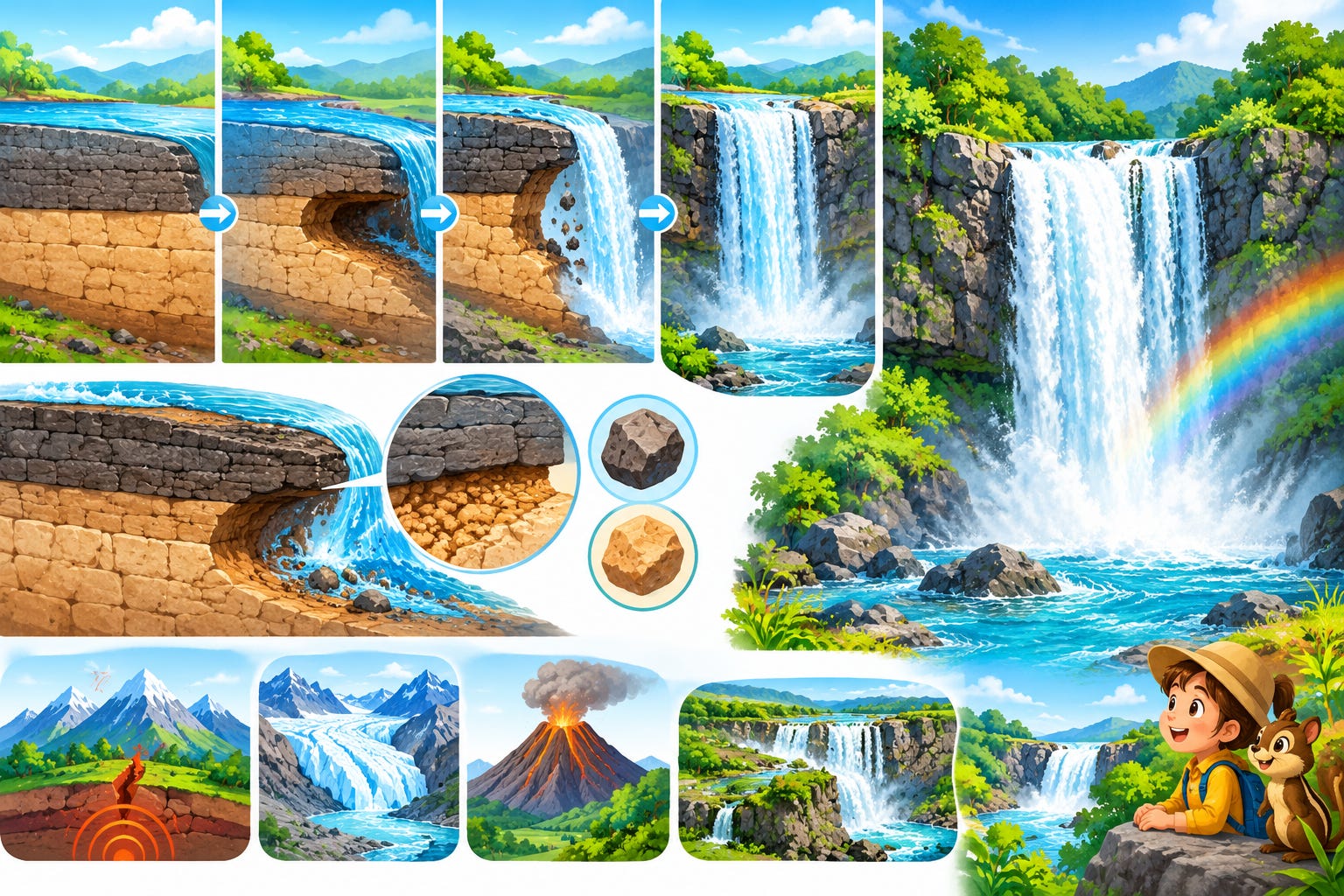
Let’s imagine a river flowing over two layers of rock.
The upper layer is made of hard rock, while the layer underneath is softer rock.
As the river flows, the softer rock begins to wear away faster.
Little by little, the softer rock is carved out.
This can create a small step in the river.
As more and more rock is removed, the step becomes steeper.
Eventually, the river reaches a drop.
And suddenly...
WHOOSH!
The water falls over the edge.
A waterfall is born!
What Happens Under the Waterfall?
Here’s where the story gets even more interesting.
Water doesn’t simply fall straight down and disappear.
When the falling water hits the rocks below, it can create a powerful swirling movement.
The water may also carry sand, pebbles, and pieces of rock.
These materials can act like tiny tools, scraping and pounding the rock at the bottom.
Over time, the falling water can carve out a hollow area beneath the waterfall.
This hollow is sometimes called a plunge pool.
Think of it as nature’s giant bowl carved into the rock!
Mountains, Earthquakes, and Glaciers Can Help Too
Waterfalls don’t all form in exactly the same way.
Sometimes the land itself changes.
For example, an earthquake can suddenly move parts of Earth’s crust up or down. If a river flows across this changed landscape, a waterfall may form.
Glaciers can also help create waterfalls.
Glaciers are huge rivers of slowly moving ice. As they move, they can carve deep valleys and reshape the land. When the ice disappears, rivers may flow over steep drops left behind by the glacier.
Volcanic activity can also create steep cliffs and different layers of rock that later become part of a waterfall.
So waterfalls can have many different stories!
Why Don’t All Waterfalls Look the Same?
Have you noticed that waterfalls come in many shapes and sizes?
Some are tall and narrow.
Some spread out like a giant curtain.
Some tumble over several rocky steps.
And some have water that splits into different streams before reaching the bottom.
The shape of a waterfall depends on things such as:
The type of rock: Hard and soft rocks wear away differently.
The shape of the land: Steep cliffs can create dramatic drops.
The amount of water: A river carrying lots of water can create a powerful waterfall.
The weather: Rain, snow, and melting ice can change how much water flows through a river.
Time: Erosion keeps changing the shape of the waterfall.
Famous Waterfalls Around the World
Our planet is home to thousands of amazing waterfalls.
Niagara Falls lies on the border between the United States and Canada. It is famous for its enormous amount of flowing water.
Angel Falls in Venezuela is one of the world’s highest uninterrupted waterfalls. Its water drops from a great height before reaching the ground below.
Victoria Falls lies on the Zambezi River between Zambia and Zimbabwe. It is famous for its enormous width and powerful spray.
Iguazu Falls, on the border of Argentina and Brazil, is actually a collection of many waterfalls rather than just one.
Each waterfall has its own shape, size, and geological story.