

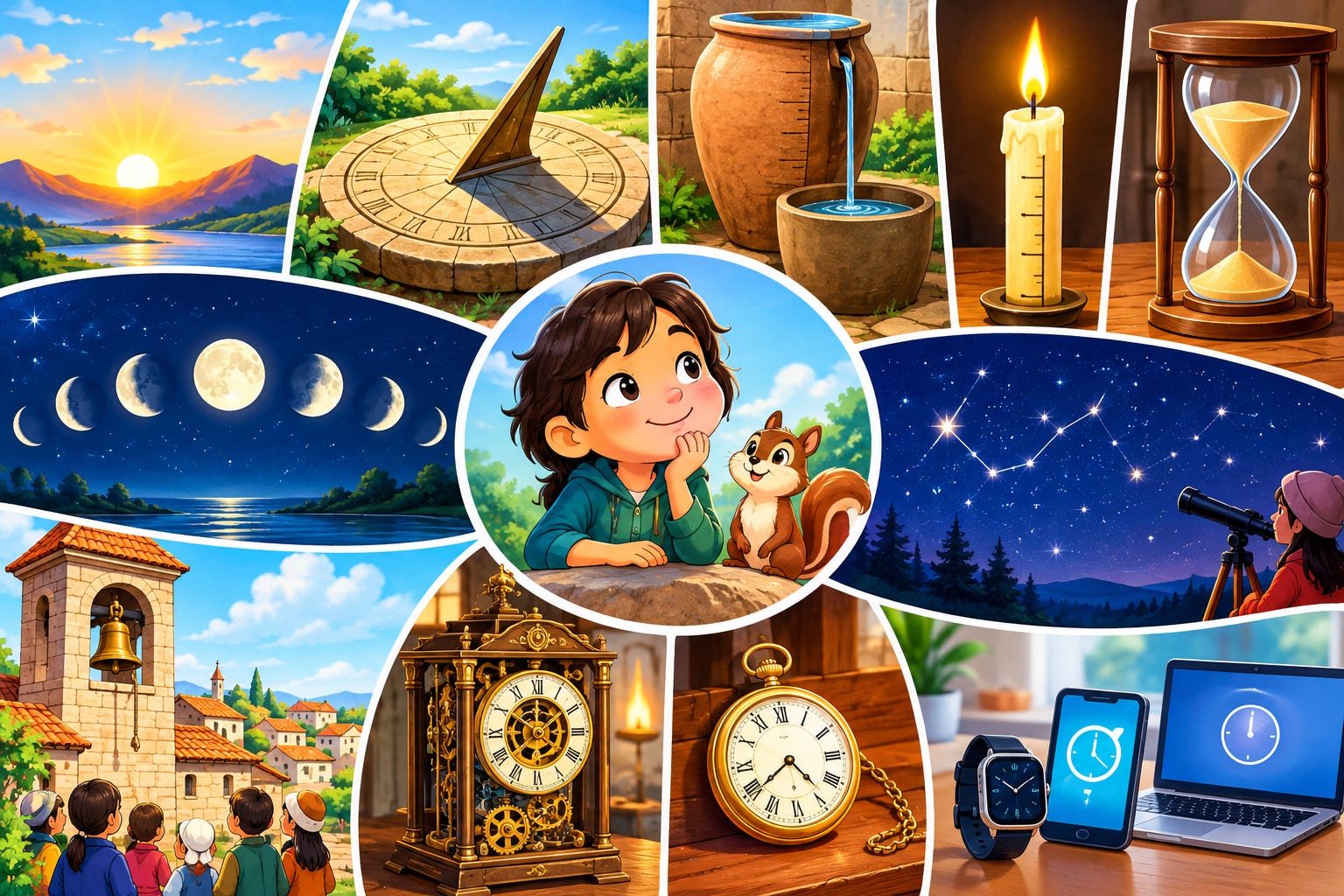
Imagine waking up tomorrow morning and discovering that every clock, watch, phone, and computer has disappeared!
How would you know when it was time for breakfast? How would you know when school should start? And how would you know when it was bedtime?
Today, checking the time is as easy as looking at a clock or phone. But people did not always have clocks. Long ago, they had to use nature, shadows, water, fire, and clever inventions to figure out how much time had passed.
Let’s travel back in time and discover how people became time detectives!
The Sun Was Nature’s Clock
Long before clocks were invented, people looked up at the sky.
The Sun rises in the east and appears to move across the sky during the day before setting in the west. People noticed that this happened again and again.
Sunrise meant the beginning of the day. When the Sun was high overhead, it was around the middle of the day. When the Sun moved toward the horizon, evening was approaching.
People could therefore use the Sun to divide their day into different parts.
Of course, the Sun did not come with numbers or hands like our clocks do. People had to become very good at judging its position!
Shadows Became Timekeepers
One of the cleverest ways people used the Sun was by watching shadows.
Imagine placing a stick upright on the ground. As the Sun moves across the sky, the stick’s shadow moves and changes length.
In the morning, the shadow is usually long. As the Sun climbs higher, the shadow becomes shorter. Later in the afternoon, it becomes long again in the opposite direction.
People learned that these changing shadows could help them estimate the time.
This idea eventually led to the invention of the sundial.
How Does a Sundial Work?
A sundial has a part that casts a shadow and a surface marked with lines or numbers.
As the Sun moves across the sky, the shadow moves across the markings. The position of the shadow gives an approximate time.
Pretty amazing, right?
But sundials had one big problem: they needed sunlight!
At night, on a very cloudy day, or indoors, a sundial was not much help.
So people came up with other ideas.
Water Clocks: Time That Flows!
What could you use when the Sun isn’t shining?
How about water?
Ancient people discovered that water could be used to measure time because it could flow at a steady rate under suitable conditions.
They created containers with small openings through which water slowly flowed. Markings on the container helped people estimate how much time had passed.
These devices are called water clocks, or clepsydras.
Water clocks were especially useful when people needed to measure time at night or indoors.
Instead of watching a shadow move, they could simply watch the water level change.
Candles That Told Time
Fire provided another clever solution.
People discovered that a candle could act as a simple timer because it slowly burned down.
Some candles were marked with lines at regular intervals. As the candle burned, people could see how much of it had disappeared and estimate how much time had passed.
Imagine having a candle that tells you when it is time for dinner!
However, candles did not always burn at exactly the same speed. A breeze, the type of wax, or the size of the flame could change how quickly they burned. So candle clocks were useful for measuring approximate periods rather than giving the exact time like modern clocks.
Sand Clocks
Another clever invention was the hourglass.
An hourglass has two glass containers joined by a narrow opening. Sand slowly falls from the top container into the bottom one.
When all the sand reaches the bottom, a certain amount of time has passed.
The amount of sand and the size of the opening could be designed to measure different periods.
Some hourglasses were used for short periods, such as a few minutes, while others measured longer periods.
Even today, you may see small sand timers used for games, cooking, or experiments!
The Moon Helped Measure Longer Time
People also looked at the Moon.
Have you ever noticed that the Moon seems to change shape? Sometimes it looks like a thin crescent, while at other times it appears almost completely round.
These changes happen in a regular cycle that takes about a month.
Ancient people noticed this pattern and used it to keep track of longer periods of time.
The word month is connected to the Moon in many languages and cultures because lunar cycles were important for early calendars.
⭐ The Stars Were Timekeepers Too
The night sky also gave people useful clues.
Ancient observers carefully watched the stars and learned that particular stars and groups of stars appeared in predictable patterns.
The stars could help people understand the seasons and navigate during journeys.
For sailors and travelers, the night sky was especially important. Without modern maps, GPS, or digital watches, the stars could help them figure out where they were and which direction they were traveling.
The sky was like a giant natural guidebook!
🔔 When the Whole Town Knew the Time
In many communities, people did not need to own their own clock.
Instead, important places such as temples, churches, or town centers could use bells or other sounds to signal parts of the day.
A bell ringing might tell people that it was time to begin work, attend a service, gather for an event, or return home.
Everyone could hear the same signal, so the whole community could follow a shared routine.
Then Came Mechanical Clocks
Eventually, people developed machines that could measure time without depending directly on sunlight, flowing water, burning candles, or falling sand.
Mechanical clocks began appearing in Europe during the Middle Ages, particularly in the late 13th and 14th centuries.
These clocks used gears and other moving parts to control the movement of the clock hands.
Over time, clocks became more accurate and smaller. They moved from large public clocks to clocks that could be placed inside homes.
Later came watches, allowing people to carry a timekeeper with them.
And today?
We have digital watches, smartphones, computers, smartwatches, and even incredibly precise atomic clocks!
The idea of dividing the day into 24 hours has very ancient roots. Ancient Egyptians used a system that divided the daytime and nighttime into groups of hours, helping establish the tradition that eventually became the 24-hour day we use today.
Curiosity and clever ideas!
So the next time you look at a clock, remember that humans spent thousands of years figuring out how to measure something we cannot see, touch, or stop—
TIME!