

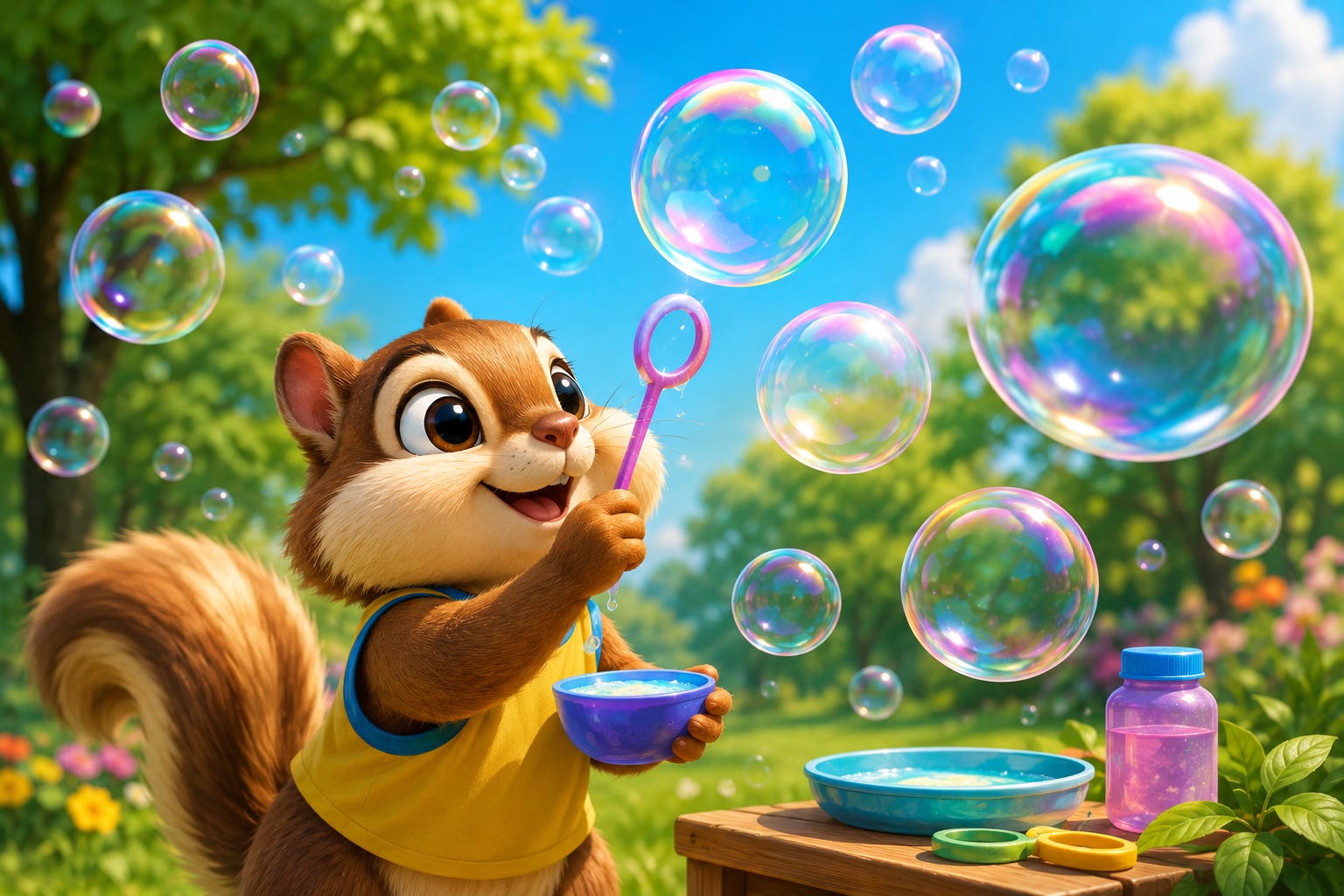
Why do bubbles float? Why are they round? And where do those beautiful rainbow colors come from?
Bubbles may look like tiny magical balls of air, but there is some amazing science hiding inside them!
The next time you blow bubbles, take a closer look. You’ll see shiny spheres floating through the air, bouncing gently, changing colors, and finally—POP!—disappearing.
What Exactly Is a Bubble?
A bubble is basically a pocket of air surrounded by a very thin film of liquid.
When you blow into bubble solution, your breath pushes air into the liquid. The soapy liquid stretches around the air, creating a thin, flexible layer.
Think of it like making a tiny balloon—but instead of rubber, the balloon is made from soapy water!
A bubble has three main parts:
💨 Air inside
💧 A thin liquid film
🌬️ Air outside
That’s it! Something so simple can create such amazing effects.
Why Doesn’t Water Make Good Bubbles?
You might think that you could make bubbles using just water. Try blowing through a straw into a glass of water and you’ll see some bubbles—but they disappear very quickly.
That’s because water molecules like to stick together.
This sticking force creates something called surface tension.
What is surface tension?
Imagine water molecules holding hands at the surface of the water. They pull on one another, creating a sort of invisible stretchy skin.
This is called surface tension.
Surface tension is why some insects can walk on water and why water droplets tend to form round shapes.
But when you try to stretch plain water into a thin bubble film, the surface tension pulls it apart too quickly.
That’s where soap comes to the rescue!
The Superpower of Soap
Soap changes the way water behaves.
Soap molecules have a special structure. One end interacts well with water, while the other end interacts better with substances that don’t mix easily with water.
When soap is added to water, the soap molecules arrange themselves along the surface of the liquid.
This reduces the surface tension and allows the water to stretch into a much thinner film.
Now the film can surround a pocket of air without breaking immediately.
And that’s how we get a bubble!
Soap doesn’t simply make bubbles because it is “slippery.” It helps create a stable, flexible film that can trap air.
Why Are Bubbles Round?
Have you ever wondered why bubbles almost always look like little spheres?
Why don’t they look like cubes, triangles, or stars?
The answer is surface tension.
The surface of a bubble is constantly trying to shrink as much as possible. A sphere is the shape that encloses a certain amount of space using the least amount of surface area.
So, the bubble naturally pulls itself into a round shape.
That’s why:
Bubble + surface tension = sphere!
Even if you blow a long bubble, it will usually try to become rounder when it is free to move.
Why Do Bubbles Float?
A bubble doesn’t really “fly” like a bird or airplane. It moves because of the air around it.
The air inside a bubble is very light, and the thin soap film doesn’t add much weight.
When a bubble is released, it can be carried upward or sideways by moving air.
That’s why bubbles can:
🫧 Rise
🫧 Drift sideways
🫧 Spin around
🫧 Move with a breeze
Have you ever blown bubbles outside on a windy day? They can travel surprisingly far!
Look closely at a bubble and you may see:
💙 Blue
💚 Green
💛 Yellow
❤️ Red
💜 Purple
But where do these colors come from?
The soap film is incredibly thin—so thin that light can reflect from both the outer and inner surfaces of the film.
These reflected light waves interact with each other. Some colors become stronger while others become weaker.
This phenomenon is called thin-film interference.
You don’t need to remember that big scientific name, but remember this:
🌈 The rainbow colors of bubbles are created when light interacts with the thin soap film.
And here’s something really cool: the colors change as the bubble gets thinner!
That’s why a bubble can look different from one moment to the next.
Why Do Bubbles Pop?
Every bubble has a limited lifetime.
But why?
One reason is evaporation.
The water in the soap film slowly turns into water vapor and escapes into the air. As the film becomes thinner, it becomes harder for the bubble to stay together.
A bubble can also pop when:
It touches something sharp.
You touch it with a dry hand.
Strong air movement disturbs it.
The liquid evaporates too quickly.
The soap film becomes too thin.
And sometimes…
POP!
It’s gone before you even know what happened.
Can Bubbles Be Different Shapes?
Here’s another interesting question:
Can you make a square bubble?
A single free-floating bubble naturally becomes round because of surface tension.
But if you use special frames or structures, you can create bubble films in unusual shapes.
For example, scientists and mathematicians use wire frames to explore how soap films arrange themselves.
The films always try to find shapes that use as little surface area as possible.
So bubbles aren’t just fun—they can also teach us about mathematics, physics, and engineering!
Why Do Two Bubbles Join Together?
Have you ever seen two bubbles bump into each other?
Sometimes they stick together!
When two bubbles meet, their films can form a shared wall between them.
If bubbles of different sizes meet, something interesting happens: the smaller bubble often has a greater pressure inside it than the larger bubble.
Bubble science can get surprisingly complicated!
This is one reason scientists study bubbles to understand things like foams, sprays, and liquid films.
The Big Bubble Mystery Solved!
So, are bubbles really magic?
Not quite!
Their magic comes from science.
Soap helps water form a thin, flexible film. Surface tension pulls that film into a round shape. The film traps air inside, while light creates beautiful colors across its surface. Eventually, evaporation or a disturbance makes the film too weak, and...
POP!
The next time you blow bubbles, remember that you’re not just playing with soapy water.
You’re holding a tiny science experiment in the air!