

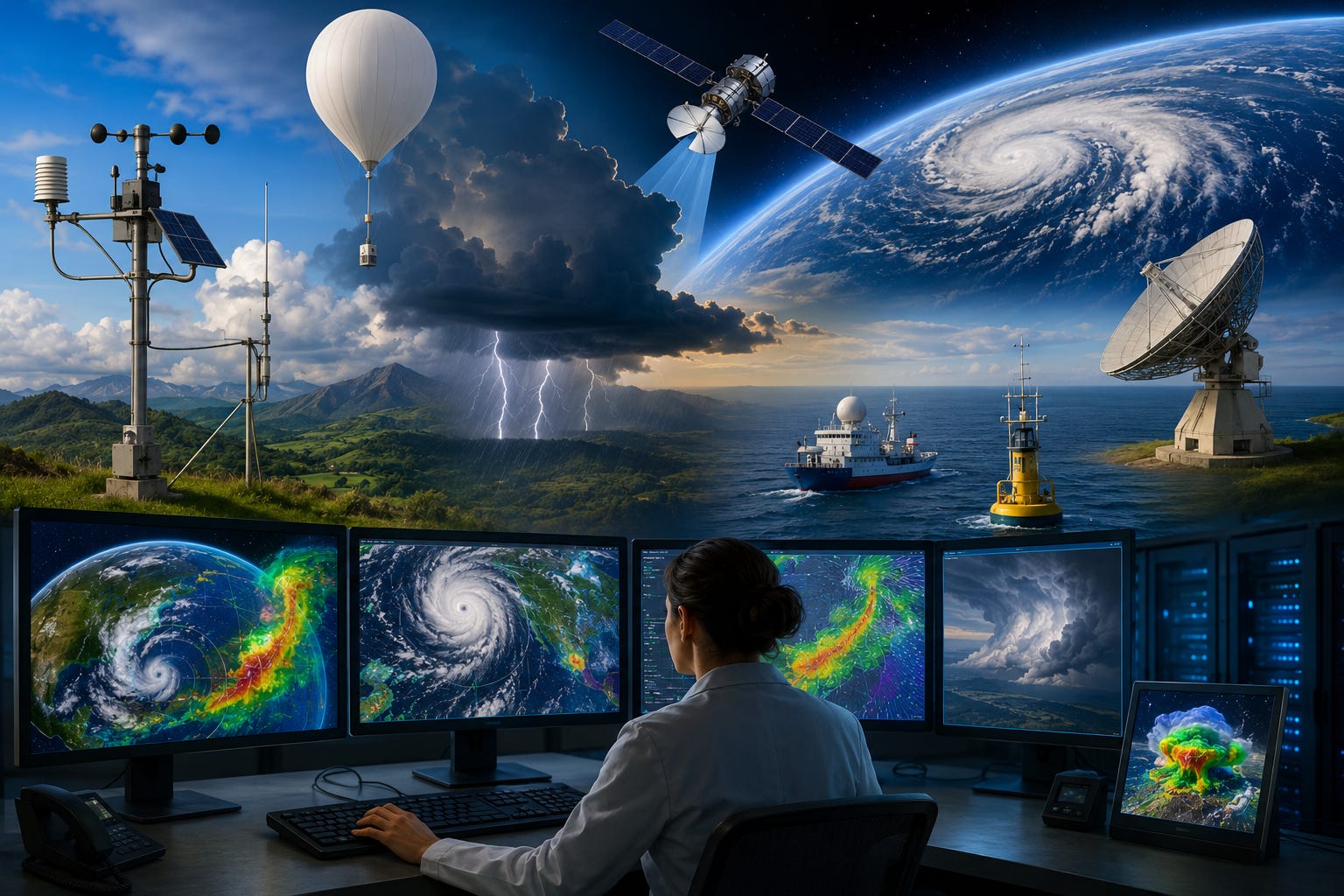
Have you ever wondered how weather reports know it might rain tomorrow or be sunny all week? Scientists don’t guess the weather—they use technology, observations, and powerful computers to predict it. This process is called weather forecasting, and it’s like solving a giant puzzle about Earth’s atmosphere!
Watching the Sky Closely
Scientists collect information about the weather every day. They measure things like:
Temperature – How hot or cold the air is.
Wind speed and direction – How fast the wind blows.
Humidity – How much water vapor is in the air.
Air pressure – Changes that can help predict storms.
Rain and snowfall – How much precipitation falls.
All these clues help scientists understand what the atmosphere is doing.
Satellites in Space Help Too
Weather satellites orbit Earth and take pictures of clouds, storms, and oceans from space. These images help scientists see where hurricanes, heavy rain, or large cloud systems are moving.
Without satellites, predicting weather far away would be much harder!
Weather Balloons Fly High
Scientists also send weather balloons high into the sky. These balloons carry tools that measure temperature, air pressure, and humidity in different layers of the atmosphere.
The information is sent back to Earth for scientists to study.
Radar Tracks Rain and Storms
Radar systems can detect rain, snow, and thunderstorms. They help scientists watch storms in real time and warn people about severe weather.
That’s why weather alerts can sometimes arrive before a big storm.
Supercomputers Make Predictions
After collecting all the information, powerful computers do millions of calculations every second. They use scientific equations to predict:
Will clouds grow bigger?
Will warm and cold air meet?
Could a storm form?
Will temperatures rise or fall?
The computer creates possible future weather patterns.
Scientists Study the Results
Meteorologists (scientists who study weather) examine the computer predictions and create weather forecasts for TV, phones, and news reports.
Even with advanced technology, forecasts aren’t always perfect because weather changes quickly.
Why Weather Forecasts Change
You may notice forecasts update often. That happens because new weather information arrives every few hours, helping predictions become more accurate.
Weather forecasting is a bit like updating a puzzle as new pieces appear!
Why Predicting Weather Matters
Weather forecasts help people:
Plan trips
Protect farms
Prepare for storms
Stay safe during extreme weather
Decide what clothes to wear
Weather predictions save lives and help communities prepare.
The next time you hear, “There’s a 70% chance of rain tomorrow,” remember—scientists used satellites, balloons, radar, and supercomputers to make that prediction. Weather forecasting is one of the coolest ways science helps us every day!
Weather may seem unpredictable, but scientists work hard to understand the sky above us.