

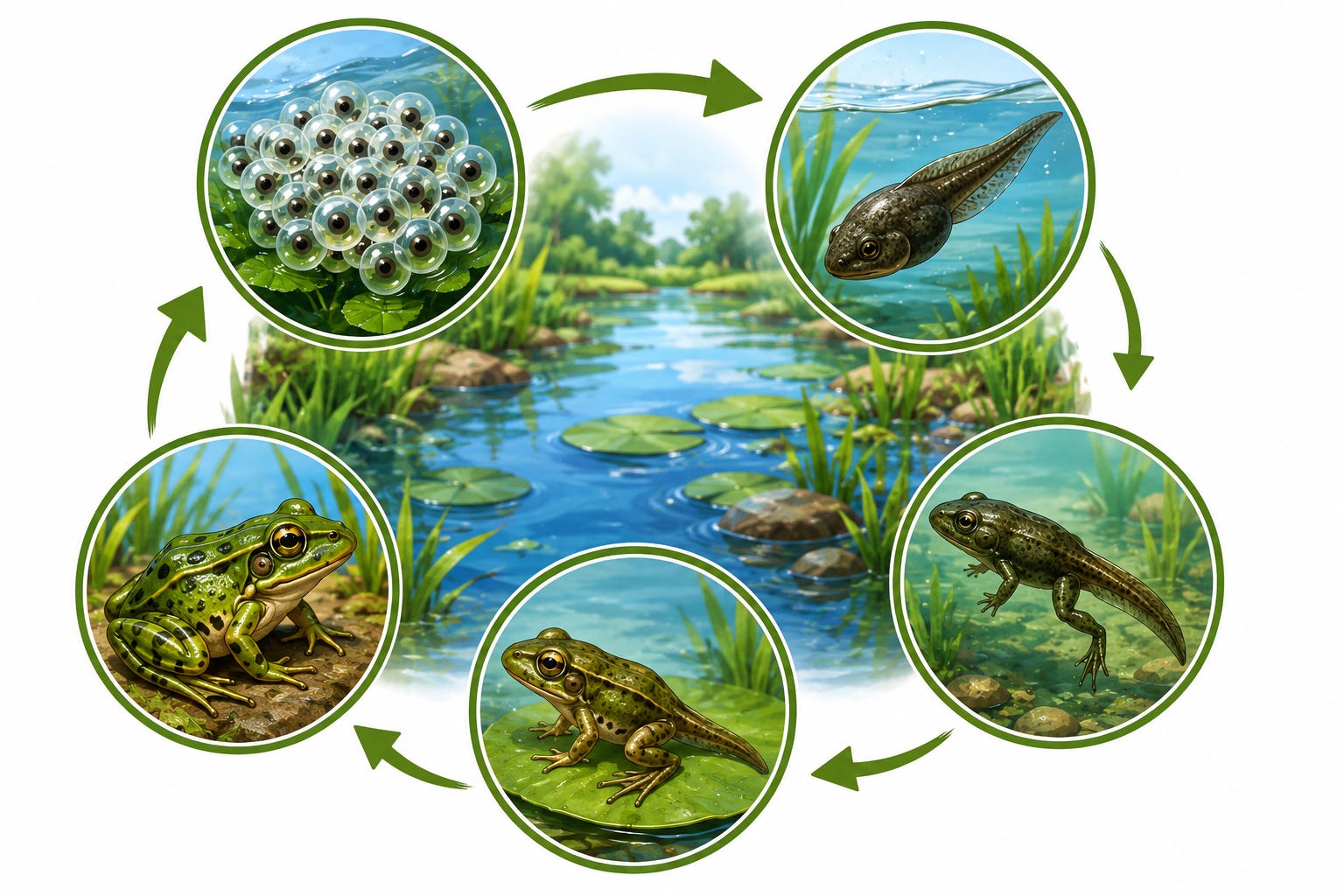
A frog goes through an amazing journey as it grows. Unlike humans, baby frogs look completely different from adult frogs. This process of changing from one form to another is called metamorphosis.
The life cycle of a frog has four main stages.
1. Egg
A frog begins its life as an egg. Female frogs lay hundreds or even thousands of soft, jelly-like eggs in ponds, lakes, or slow-moving streams. The jelly around the eggs protects the tiny babies growing inside.
After a few days or weeks, depending on the weather, the eggs hatch.
Fun Fact: A group of frog eggs is called frogspawn.
2. Tadpole
When the egg hatches, a tiny tadpole comes out.
At this stage:
It lives completely in water.
It breathes through gills, just like a fish.
It has a long tail for swimming.
It does not have legs yet.
It mostly eats algae and other tiny plants.
The tadpole spends several weeks growing bigger.
3. Froglet
As the tadpole grows, it slowly changes into a froglet.
During this stage:
Back legs appear first.
Front legs grow later.
Lungs develop so it can breathe air.
The tail becomes shorter and shorter.
It starts spending time both in water and on land.
The froglet is beginning to look like a real frog.
4. Adult Frog
Finally, the tail disappears completely, and the frog becomes an adult.
An adult frog:
Breathes with lungs and through its moist skin.
Lives on land and in water.
Eats insects, worms, spiders, and other small animals.
Can jump long distances with its powerful back legs.
Eventually lays eggs, starting the life cycle all over again.
The Metamorphosis Process
The transformation from tadpole to frog is called metamorphosis. During metamorphosis, the frog’s body changes in many ways:
Gills disappear.
Lungs develop.
Legs grow.
The tail shrinks away.
The diet changes from mostly plants to small animals.
These changes help the frog survive both in water and on land.
Life Cycle at a Glance
Egg → Tadpole → Froglet → Adult Frog → Eggs
Amazing Frog Facts
Some frogs can lay over 4,000 eggs at one time.
Not all frog eggs survive because many are eaten by fish, birds, or insects.
Frogs are amphibians, which means they can live both in water and on land.
There are more than 8,000 species of frogs around the world.
Frogs use their sticky tongues to catch insects in a flash!
Conclusion
The life cycle of a frog is one of nature’s most fascinating transformations. From a tiny jelly-like egg to a swimming tadpole, then a froglet, and finally an adult frog, each stage is important. This incredible journey helps frogs adapt to different environments and continue their life cycle for generations to come.
Free Frog Life Cycle Worksheet
Want to help your child remember what they learned?
I’ve created a free printable Frog Life Cycle Worksheet filled with fun activities, matching exercises, and drawing challenges.
🖨️ Print it at home for a screen-free learning activity.

📄 Download the PDF and let your child complete it at their own pace.
I’d love to see your child’s finished worksheet! Feel free to share a photo in the comments or tag us on social media.
Learning science is more fun with a quiz! Test your knowledge with fun quiz on ChatteringChipmunks YouTube channel and see if you can score 10/10!
Watch here: