

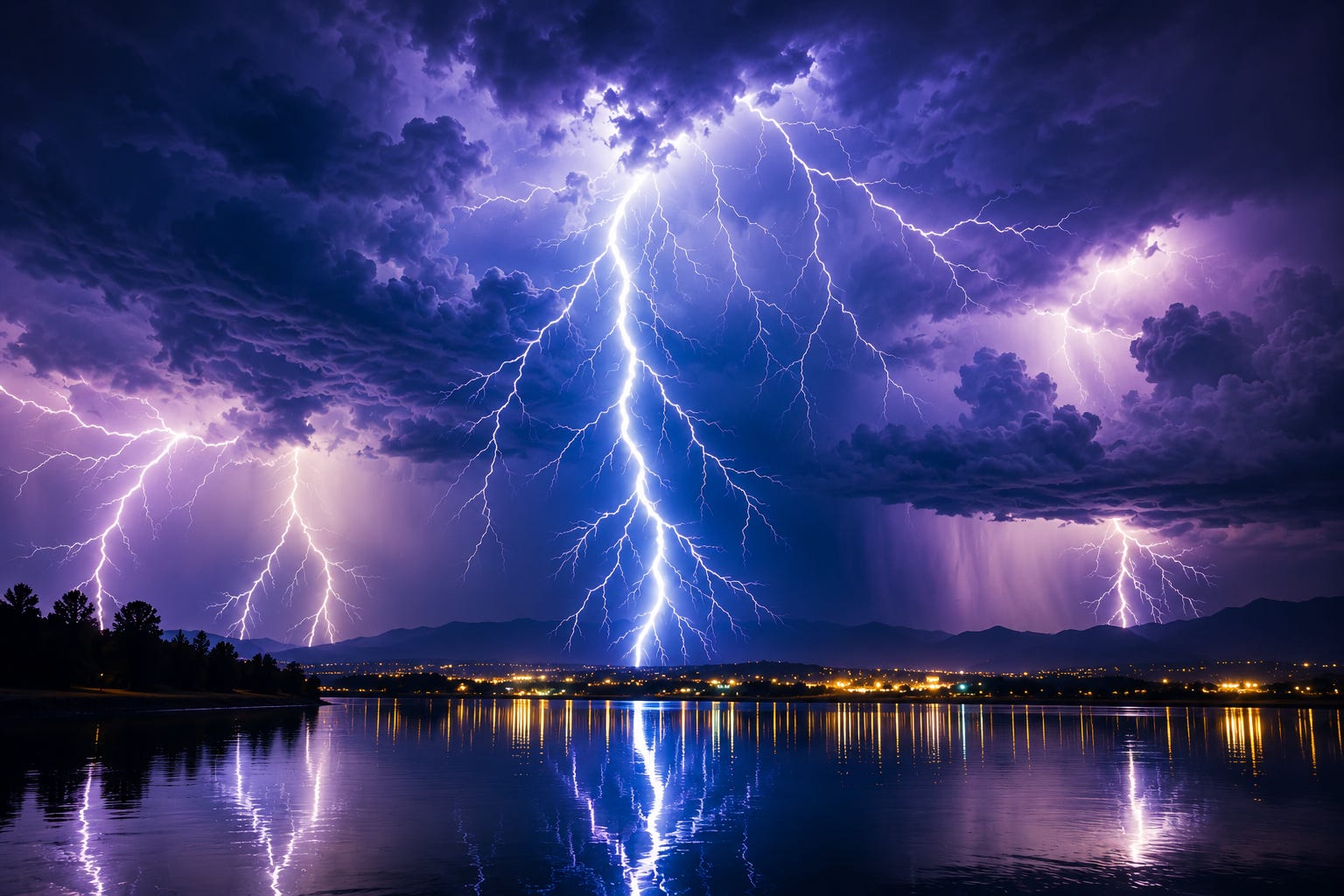
A flash of light races across the sky. A few seconds later, a loud rumble shakes the air. What you have just witnessed is one of nature’s most exciting and powerful displays—lightning!
Lightning has fascinated people for thousands of years. Ancient civilizations often believed it was a message from the gods. Today, scientists understand that lightning is a giant electrical spark created by storms, but it is still just as amazing to watch.
What Is Lightning?
Lightning is a sudden discharge of electricity in the atmosphere. It occurs when large amounts of electrical energy build up inside storm clouds and then rapidly flow from one place to another.
Think about rubbing a balloon on your hair. The balloon becomes electrically charged and can make your hair stand up. Lightning works in a similar way, but on a much larger scale. Instead of a tiny spark, lightning produces a gigantic spark that can stretch for many kilometers across the sky.
How Does Lightning Form?
Lightning usually forms inside large storm clouds called cumulonimbus clouds.
Inside these clouds, strong winds move water droplets, ice crystals, and hailstones up and down. As these particles bump into each other, they create electrical charges.
Over time:
Positive charges gather in one area.
Negative charges gather in another area.
The difference between these charges becomes greater and greater.
Eventually, the electrical attraction becomes so strong that the air can no longer act as an insulator. A powerful electrical current suddenly shoots through the air, creating a brilliant flash of lightning.
Different Types of Lightning
Cloud-to-Ground Lightning
This is the type most people think of when they hear the word “lightning.” The electrical discharge travels between a cloud and the Earth’s surface.
Cloud-to-Cloud Lightning
Sometimes lightning jumps from one cloud to another without touching the ground.
Intra-Cloud Lightning
Many lightning flashes occur within the same cloud. These flashes often make entire clouds glow brightly.
Forked Lightning
This lightning branches into several paths, creating the familiar zigzag pattern often seen in photographs.
Sheet Lightning
Sheet lightning lights up large sections of the sky, making clouds appear to flash from within.
Why Is Lightning So Bright?
Lightning is incredibly bright because it releases a huge amount of energy in a very short time.
The electrical current heats the surrounding air to temperatures of about 30,000°C (54,000°F)—roughly five times hotter than the surface of the Sun! This intense heat causes the air to glow, producing the brilliant flash we see.
Why Does Thunder Happen?
Lightning and thunder are actually part of the same event.
When lightning heats the air, the air expands extremely quickly. This rapid expansion creates a shock wave that travels through the atmosphere.
We hear this shock wave as thunder.
Because light travels much faster than sound, we see the flash first and hear the thunder a few seconds later.
How Far Away Is Lightning?
You can estimate how far away a lightning strike is by counting the seconds between the flash and the thunder.
For every 3 seconds between the flash and the thunder, the lightning is about 1 kilometer away.
For example:
3 seconds = about 1 kilometer away
6 seconds = about 2 kilometers away
9 seconds = about 3 kilometers away
This simple trick helps meteorologists and weather enthusiasts judge the distance of a storm.
Amazing Lightning Facts
⚡ Earth experiences around 8 million lightning strikes every day.
⚡ A single lightning bolt can contain enough energy to power a small town for a short time.
⚡ Lightning can strike the same place more than once. Tall buildings and towers are often struck repeatedly.
⚡ Some lightning bolts travel horizontally across the sky for over 100 kilometers.
⚡ Lightning plays a role in nature by helping produce compounds that enrich the soil with nutrients important for plant growth.
⚡ Scientists have discovered rare forms of lightning called sprites, blue jets, and elves, which occur high above thunderstorms.
Is Lightning Dangerous?
Yes. Lightning is extremely powerful and can be dangerous to people, animals, and buildings.
A lightning strike can:
Cause serious injuries.
Start fires.
Damage electrical equipment.
Knock out power supplies.
That is why it is important to take thunderstorms seriously.
Lightning Safety Tips
When you hear thunder, remember this simple rule:
“When thunder roars, go indoors!”
Here are some important safety tips:
✅ Stay inside a building or vehicle.
✅ Avoid open fields and hilltops.
✅ Stay away from isolated trees.
✅ Do not swim during a thunderstorm.
✅ Avoid using electrical appliances connected to outlets.
✅ Stay away from metal fences, poles, and other tall metal objects.
How Do Buildings Stay Safe?
Many tall buildings have lightning rods installed on their roofs.
A lightning rod is a metal rod connected to the ground by a wire. If lightning strikes the building, the electricity safely travels through the rod and into the ground instead of damaging the structure.
This invention, developed by Benjamin Franklin, has protected buildings for centuries.
Lightning is one of nature’s most spectacular displays. It lights up dark skies, powers thunder, and reminds us of the incredible forces at work in Earth’s atmosphere. Although it can be dangerous, it also helps scientists better understand weather, electricity, and our planet.
The next time a storm rolls in and you see a bright flash across the sky, take a moment to appreciate the amazing science behind one of nature’s greatest light shows!