

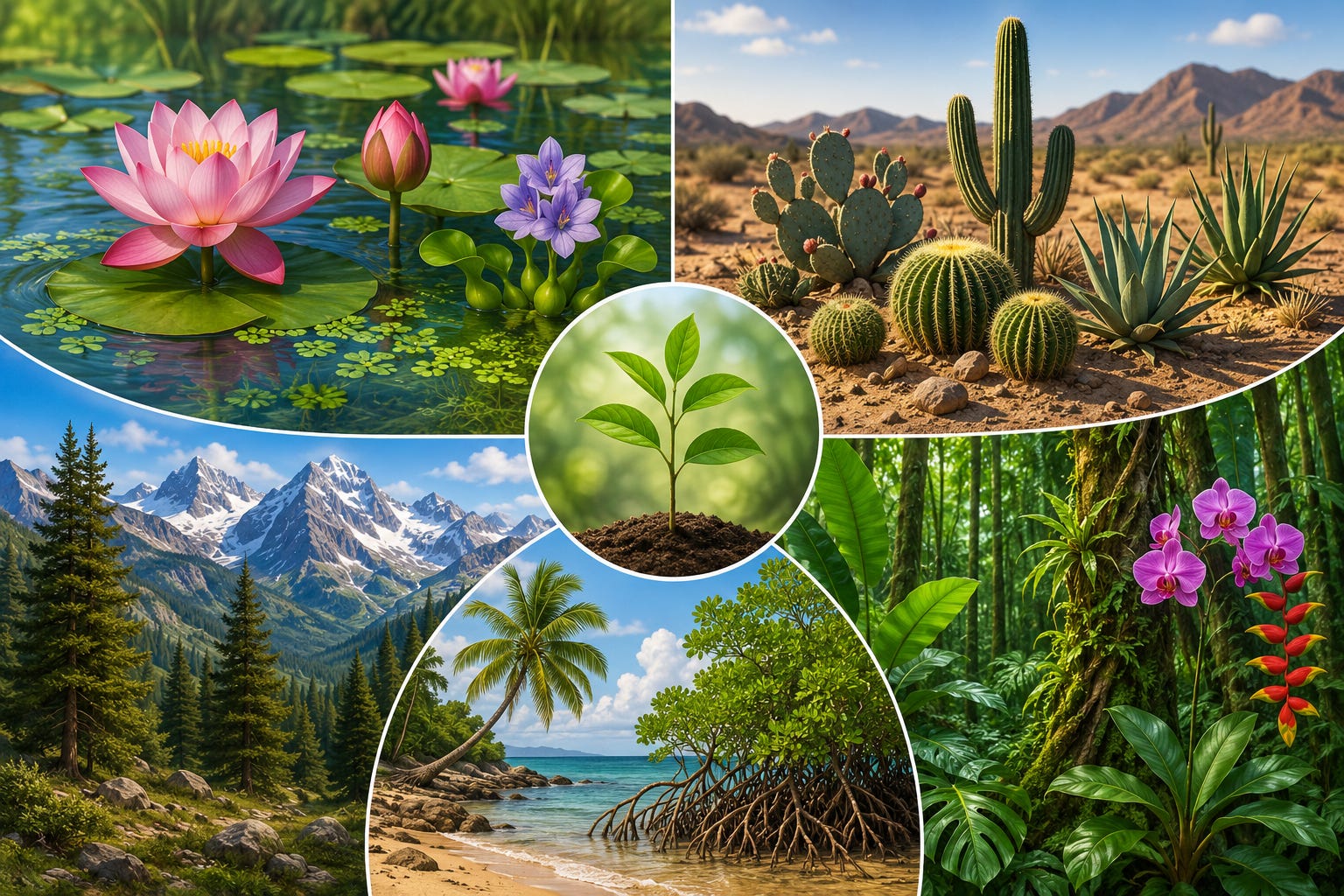
Have you ever wondered why a cactus can survive in a hot desert but a lotus grows happily in a pond? Or why coconut trees love the beach while pine trees thrive on snowy mountains?
Plants grow almost everywhere on Earth, but not all places are the same. Some places are hot and dry, some are cold and snowy, while others receive heavy rainfall or are surrounded by water. Over millions of years, plants have adapted to live in these different environments.
Let’s explore the amazing world of plants and discover how they survive in different habitats!
What Are Plant Habitats?
A habitat is the natural home where a plant grows best. Every habitat has different weather, soil, water, and sunlight. Plants have special features that help them survive in their own habitat.
Some plants need lots of water, while others store water for months. Some love salty air near the sea, while others enjoy freezing mountain temperatures.
Let’s meet them!
1. Aquatic Plants (Water Plants)
Aquatic plants grow in or near water. They can be found in ponds, lakes, rivers, marshes, and wetlands.
Amazing Adaptations
Broad, flat leaves float on water.
Air spaces inside stems help them float.
Flexible stems bend with moving water.
Some roots are small because water provides support and nutrients.
Examples
Lotus
Water Lily
Duckweed
Water Hyacinth
Hydrilla
Fun Fact
The giant water lily can have leaves over 2 meters wide—large enough to support the weight of a small child for a short time!
2. Desert Plants
Deserts receive very little rainfall and are extremely hot during the day.
Desert plants have developed clever ways to save water.
Amazing Adaptations
Thick stems store water.
Spines replace leaves to reduce water loss.
Deep or wide roots collect every drop of rain.
A waxy coating prevents evaporation.
Examples
Cactus
Aloe Vera
Agave
Date Palm
Prickly Pear
Fun Fact
Some cacti can survive months or even years without rainfall!
3. Mountain Plants
Mountain regions are cold, windy, and often snowy.
Plants growing here must survive freezing temperatures.
Amazing Adaptations
Cone-shaped trees help snow slide off.
Needle-like leaves reduce water loss.
Thick bark protects against cold.
Flexible branches prevent breaking under snow.
Examples
Pine
Fir
Cedar
Spruce
Juniper
Fun Fact
Many evergreen trees stay green throughout the year, even during snowy winters.
4. Rainforest Plants (Rainy Region Plants)
Rainforests receive heavy rainfall throughout the year and are home to the greatest variety of plants on Earth.
These forests are warm, humid, and full of life.
Amazing Adaptations
Large leaves collect sunlight.
Drip-tip leaves help rainwater run off quickly.
Tall trees compete for sunlight.
Many plants climb trees to reach sunlight.
Examples
Rubber Tree
Bamboo
Banana Plant
Orchid
Fern
Fun Fact
Rainforests cover only about 6% of Earth’s land, but they are home to more than half of all plant and animal species!
5. Coastal Plants
Coastal plants grow near oceans and seas.
They face salty water, strong winds, sandy soil, and high tides.
Amazing Adaptations
Strong roots hold plants in loose sand.
Thick leaves reduce water loss.
Some plants can remove extra salt.
Flexible stems bend with strong sea winds.
Examples
Coconut Tree
Mangrove
Sea Oats
Pandanus
Beach Morning Glory
Fun Fact
Mangrove forests protect coastlines from storms and help prevent soil erosion.
Why Are Plant Adaptations Important?
Without these special adaptations, many plants would not survive.
Adaptations help plants:
Save water
Get sunlight
Stay warm or cool
Grow in salty soil
Survive heavy rain
Stand strong against wind
Reproduce successfully
Every plant is perfectly suited to its own home.
Did You Know?
🌱 Bamboo is one of the fastest-growing plants and can grow up to 90 cm (about 3 feet) in a single day under ideal conditions!
🌵 A cactus stores water like a natural water bottle.
🌸 Lotus flowers open in the morning and close at night.
🌲 Pine trees keep their leaves all year round.
🌴 Coconut trees can survive salty sea air that many other plants cannot.
🌿 Mangroves provide safe homes for fish, crabs, birds, and many other animals.
Conclusion
From floating lotus flowers to prickly cacti, snowy pine trees to towering rainforest giants, and swaying coconut palms along the beach, plants have found incredible ways to live in every corner of our planet.
Each habitat teaches us how nature adapts to challenges. The next time you see a plant, take a closer look—you might discover the amazing features that help it survive in its unique home.
Nature is full of wonderful surprises, and every plant has its own incredible story to tell! 🌿
Free Plants of Every Habitat Worksheet
Want to help your child remember what they learned?
I’ve created a free printable Plants of Every Habitat Worksheet filled with fun activities, matching exercises, and drawing challenges.

🖨️ Print it at home for a screen-free learning activity.
📄 Download the PDF and let your child complete it at their own pace.
I’d love to see your child’s finished worksheet! Feel free to share a photo in the comments or tag us on social media.