

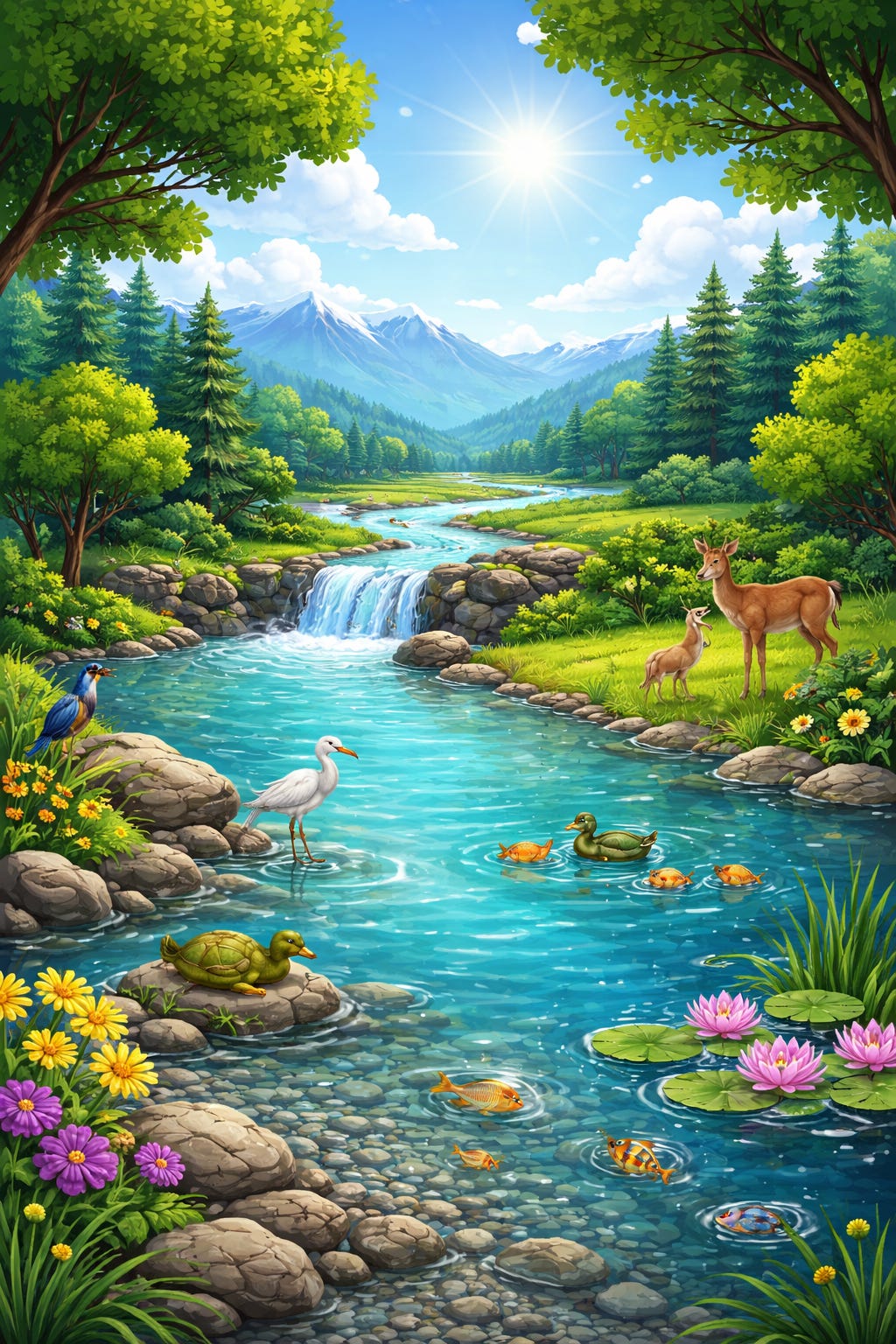
Rivers are one of the most amazing natural features on Earth. A river is a long, flowing body of water that moves across the land. Most rivers begin in mountains, hills, or glaciers where rainwater and melting snow collect. The water then flows downhill, forming streams that slowly grow into larger rivers. Eventually, many rivers end their journey by flowing into lakes, seas, or oceans.
Rivers have shaped our planet for millions of years. They carve valleys, create beautiful landscapes, and support many living things. Without rivers, life on Earth would be very different.
How Rivers Are Formed
Rivers usually start in places where there is plenty of rain or melting snow. When rain falls on mountains or hills, the water flows down the slopes. Small streams form first. These streams join together and become bigger and stronger, eventually forming a river.
As rivers flow, they slowly wear away the land through a process called erosion. Over many years, rivers can cut deep valleys and create winding paths across the land. Sometimes rivers even create waterfalls, where water drops steeply from high rocks.
Parts of a River
A river has different parts during its journey.
The source is the place where the river begins. This is often in mountains, glaciers, or springs.
The course is the path the river follows as it flows across the land. Some rivers flow straight, while others curve and twist.
The mouth is where the river ends, usually by flowing into a sea, ocean, or lake.
Along the way, smaller rivers or streams called tributaries may join the main river and make it larger.
Why Rivers Are Important
Rivers are extremely important for both people and nature. For thousands of years, human civilizations have grown near rivers because they provide fresh water. People use river water for drinking, cooking, washing, and farming.
Farmers depend on rivers to water their crops. In many places, rivers are also used to produce electricity through hydroelectric dams. Rivers can even be used for transportation, allowing boats and ships to carry goods from one place to another.
Rivers also play an important role in nature. They support many plants and animals. Fish, turtles, frogs, insects, and birds all depend on rivers to survive. The plants growing along riverbanks help prevent soil from washing away and provide shelter for wildlife.
Famous Rivers Around the World
Some rivers are so large and powerful that they are known all over the world.
The Nile River in Africa is one of the longest rivers on Earth and has supported ancient civilizations for thousands of years.
The Amazon River in South America carries more water than any other river in the world and flows through the huge Amazon rainforest.
In India, the Ganges River is very important for millions of people. It provides water for farming and is also considered sacred in many cultures.
Protecting Our Rivers
Even though rivers are powerful, they can be harmed by pollution. Throwing garbage, plastic, or chemicals into rivers can make the water dirty and unsafe for animals and people.
We can all help protect rivers by keeping them clean, reducing waste, and using water wisely. Planting trees near rivers also helps protect the soil and keeps riverbanks strong.
When we take care of rivers, we protect the plants, animals, and people who depend on them.