

Have you ever wondered how a heavy box can be moved without using too much strength? Or how a bicycle moves so easily when you push the pedals? How about opening a bottle, cutting a piece of paper, or climbing up a ramp?
The answer to many of these everyday mysteries is simple machines!
Simple machines are tools that help us do work more easily. They can help us lift, move, cut, push, pull, or turn things. They don’t do the work for us, but they can make the work easier by changing the amount or direction of the force we need.
And here’s the amazing part: simple machines are everywhere!
You may already be using them without even realizing it.
Let’s go on a little adventure and discover the six basic simple machines hiding all around us!
A simple machine is a device with a basic design that helps us use force more effectively.
Imagine trying to lift a heavy stone with just your hands. It might be very difficult. But if you use a lever, you may be able to move it much more easily.
Simple machines can help us by:
Making a job easier
Changing the direction of a force
Helping us move heavy objects
Helping us cut or split things
Helping us lift objects higher
Helping us turn or move things
There are six basic types of simple machines:
Lever, wheel and axle, pulley, inclined plane, wedge, and screw.
Let’s meet them!
1. The Lever – A Little Push Can Do a Big Job!
A lever is a stiff bar that moves around a fixed point called a fulcrum.
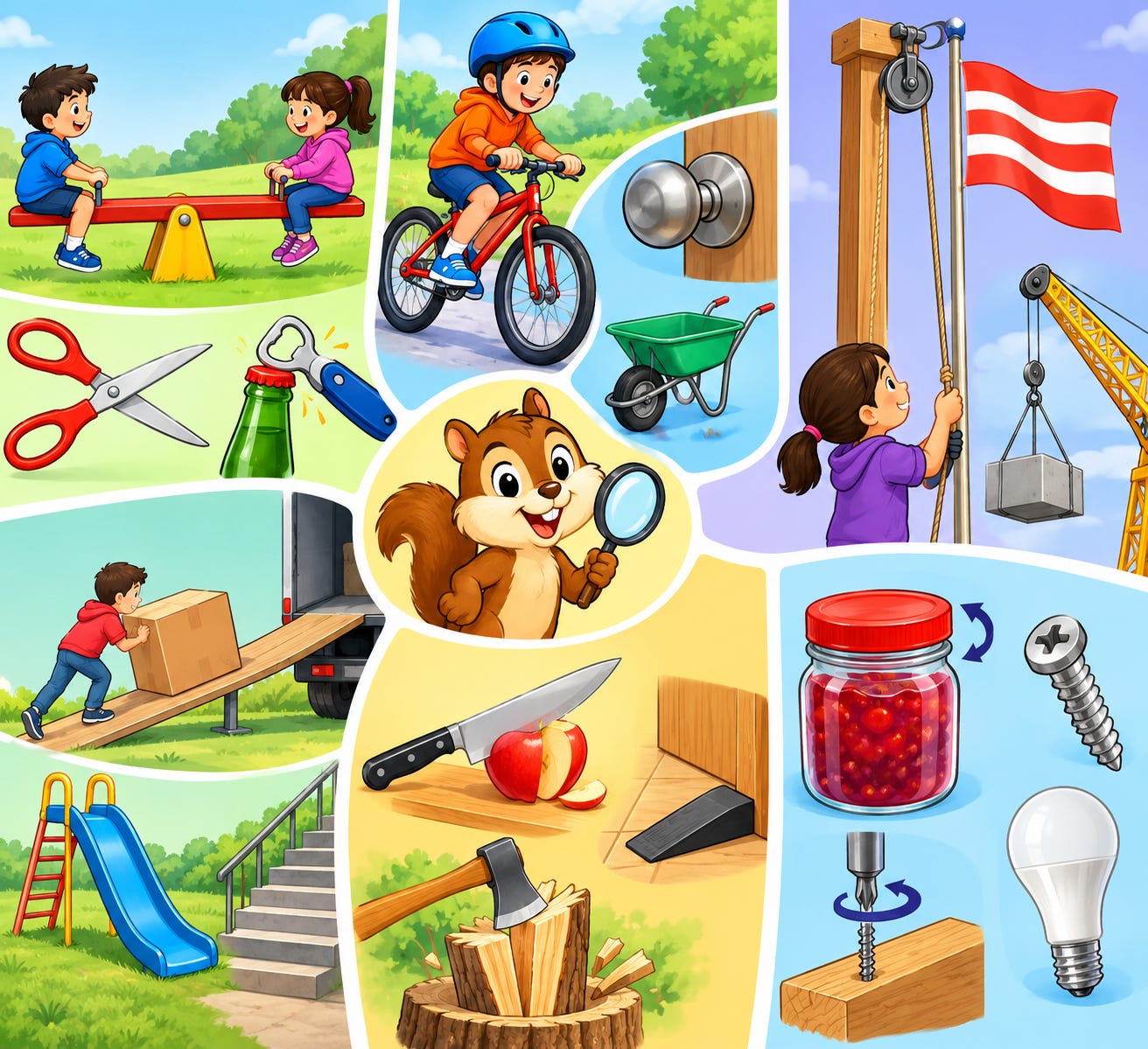
A seesaw is a great example.
When one child pushes down on one side of a seesaw, the other side moves upward. The middle part acts as the fulcrum.
Levers are found in many everyday objects.
Think about scissors. When you squeeze the handles, the blades move and cut the paper. The point where the two blades are joined acts as the fulcrum.
A bottle opener is another example. You push down on the handle, and the opener lifts the bottle cap.
Even a crowbar is a lever. It can help move or lift heavy objects that would be difficult to move with your hands alone.
Look around you!
You can find levers in:
Seesaws
Scissors
Bottle openers
Fun Fact!
Your own body uses levers! Your bones and muscles work together like a system of levers to help you move your arms, legs, and other body parts.
2. Wheel and Axle – Let’s Get Rolling!
Have you ever wondered why wheels make moving things so much easier?
A wheel and axle is a simple machine made of a large round wheel attached to a smaller rod called an axle.
When the wheel turns, the axle turns with it.
Think about a bicycle. When you pedal, the wheels turn and help the bicycle move forward.
A doorknob is another example. When you turn the large knob, the smaller mechanism inside turns too, helping open the door.
You can also find wheel-and-axle systems in:
Bicycles
Cars
Shopping carts
Imagine trying to move a heavy suitcase by dragging it across the floor. Now imagine pulling the same suitcase on wheels.
Much easier, right?
That’s the magic of the wheel!
Fun Fact!
The invention of the wheel was one of the most important developments in human history. Wheels helped people transport heavy objects and eventually led to many machines and vehicles we use today.
3. The Pulley – Lift It Up!
Have you ever seen a flag being raised on a flagpole?
A rope moves through a small wheel at the top of the pole, allowing the flag to move upward.
That clever device is called a pulley.
A pulley is a wheel with a groove around it. A rope, cable, or chain passes through the groove.
Pulling the rope in one direction can help move an object in another direction.
Pulleys are especially useful for lifting things.
You might see pulleys being used with:
Flagpoles
Cranes
Construction equipment
Elevators
Imagine having to climb all the way to the top of a flagpole every time you wanted to raise a flag. That would be quite a workout!
A pulley lets you stand on the ground and pull the rope downward while the flag moves upward.
Fun Fact!
Large cranes often use pulley systems to help lift extremely heavy objects at construction sites.
4. The Inclined Plane – A Sloping Solution!
An inclined plane is simply a flat surface that is tilted or sloped.
A ramp is one of the easiest examples.
Imagine you need to move a heavy box into a truck. Lifting the box straight up might be difficult. But if you use a ramp, you can push the box upward along the slope.
You travel a greater distance, but you don’t have to lift the object straight upward.
Inclined planes are everywhere!
You can find them in:
Ramps
Slides
Sloping roads
Even a staircase is related to the idea of an inclined plane. Instead of climbing straight upward, you move upward gradually.
Fun Fact!
Roads going up steep hills are often built with curves or slopes instead of going straight up. This makes it easier for vehicles to travel upward.
5. The Wedge – A Tiny Tool With a Sharp Job!
A wedge is a simple machine that has one or two sloping sides and a sharp edge.
Its job is often to cut, split, or separate things.
A knife is a familiar example.
When you push a knife into an apple, the sharp edge helps separate the apple into pieces.
Other examples include:
Axes
Nails
Knives
Think about a doorstop. You slide the wedge-shaped object underneath a door, and it prevents the door from moving.
A wedge can also help split materials apart.
An axe, for example, uses a wedge-shaped blade to split wood.
Fun Fact!
Your teeth act a little like wedges too! The sharp edges of some teeth help bite and break food into smaller pieces.
So the next time you eat an apple, remember—you are using a natural cutting tool!
6. The Screw – More Than Just a Tiny Metal Object!
A screw may look simple, but it is actually a clever machine.
A screw is basically an inclined plane wrapped around a cylinder.
The spiral part of a screw is called a thread.
When you turn a screw, the threads help it move into a material or hold two objects together.
You can find screws in:
Furniture
Toys
Bicycles
Machines
Even a jar or bottle with a screw-on lid uses the idea of a screw.
When you twist the lid, the spiral threads help it move downward and hold the lid tightly in place.
Fun Fact!
The threads of a screw allow a small turning force to create a strong holding force. That’s why screws are so useful for joining things together.
Simple Machines Can Work Together
Here’s something really cool: simple machines don’t always work alone.
Many machines around us combine two or more simple machines.
Take a bicycle, for example.
Its wheels use the wheel-and-axle principle. Its pedals and crank system use lever-like action. Gears and other parts work together to help transfer your effort into movement.
A pair of scissors is also interesting. Each handle and blade works like a lever, while the sharp blades act like wedges.
A wheelbarrow combines a wheel and axle with a lever.
So when you look at a machine, you may actually be looking at several simple machines working together!