

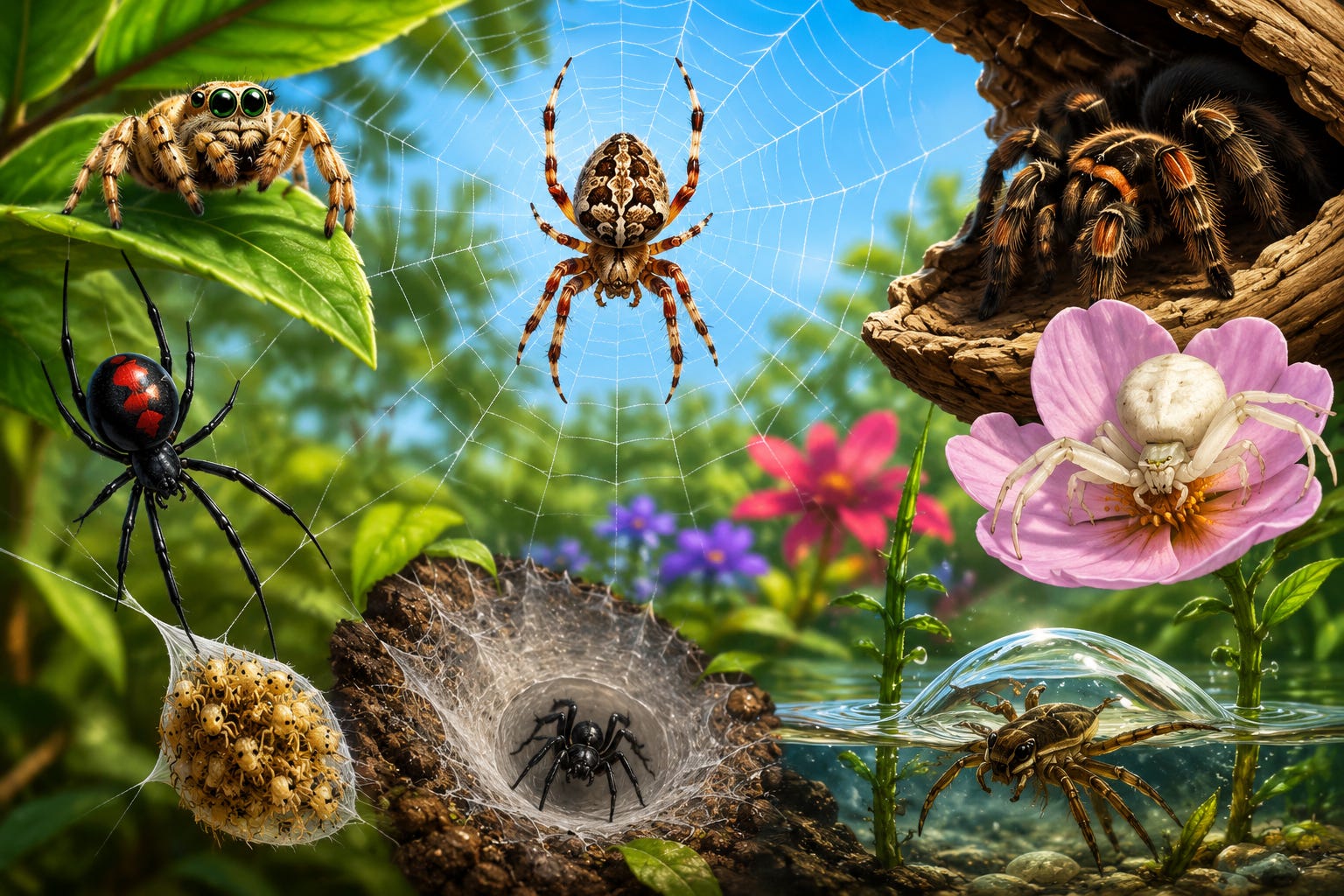
Spiders may look a little creepy to some people, but these fascinating creatures are much more than creepy-crawlies. They are skilled hunters, expert silk-makers, clever architects, and important members of nature’s team.
Spiders belong to a group of animals called arachnids. They are related to scorpions, ticks, and mites. Unlike insects, which have six legs and three main body sections, spiders have eight legs and two main body sections.
There are thousands of different kinds of spiders living in forests, gardens, deserts, grasslands, caves, and even inside our homes. Some are tiny enough to fit on your fingertip, while others can be surprisingly large.
So, let’s step into the fascinating world of spiders!
Meet the Spider
At first glance, a spider might look like a tiny ball with eight legs sticking out of it. But its body is actually quite interesting.
A spider has two main body sections.
The front section is called the cephalothorax. It contains the spider’s eyes, mouthparts, and legs. The back section is called the abdomen, which contains many of the spider’s internal organs.
And, of course, there are those eight famous legs!
Spiders also have tiny structures called spinnerets at the end of their abdomen. These are where they produce their amazing silk.
But here’s something surprising: not all spiders have eight eyes!
Many spiders do have eight eyes, but some have six, four, two, or even no eyes at all. Their eyesight also varies greatly. Some spiders see very well, while others depend more on touch, vibrations, and other senses.
How Does a Spider Make a Web?
A spider’s web may look delicate, but it is an incredible piece of natural engineering.
Spiders produce silk using special glands in their bodies. The silk begins as a liquid but becomes a strong thread when it is released.
The spider uses its spinnerets to produce and control the silk. It can then use the silk to build webs, make shelters, wrap prey, protect eggs, or even help it travel.
Some spiders create beautiful orb webs, which have a circular pattern. Others make messy-looking cobwebs, funnel-shaped webs, or flat sheet webs.
Building a web takes skill and patience. The spider carefully creates strands in patterns that help it catch prey.
And here’s another surprise:
Not every spider makes a web to catch food!
Some spiders prefer to chase their prey. Others hide and wait for an unsuspecting insect to come close.
Spider Silk: Nature’s Amazing Thread
Spider silk is one of the most remarkable materials found in nature.
It is incredibly strong for its weight, while also being flexible. Different spiders produce different kinds of silk for different purposes.
A spider may use silk to:
Build a web
Wrap captured prey
Protect its eggs
Make a hiding place
Create a safety line
Travel through the air
Some spiders even leave a silk safety line behind as they move around. If they fall, the line can help prevent them from dropping too far.
Imagine having your own built-in safety rope!
What Do Spiders Eat?
Most spiders are carnivores, which means they eat other animals.
Their meals often include insects such as flies, mosquitoes, moths, beetles, and grasshoppers. Some larger spiders can also catch and eat other small animals.
But spiders don’t chew their food like we do.
A spider uses its fangs to bite its prey. Many spiders inject venom that helps immobilize or kill their prey. The spider can then release digestive fluids that break down the food.
Instead of taking a big bite and chewing, the spider essentially turns its meal into a form it can suck up!
It’s a very different kind of dinner.
How Does a Spider Catch Its Prey?
Different spiders have different hunting strategies.
A web-building spider may wait patiently for an insect to become trapped. When the insect struggles, its movements can create vibrations in the web.
The spider senses these vibrations and rushes toward its meal.
It may then bite the prey and sometimes wrap it in silk.
But jumping spiders have a completely different strategy.
They can stalk and jump onto their prey. They often have excellent eyesight and can carefully judge distances before making their move.
Other spiders hide and wait for prey to come close before suddenly attacking.
Spiders may be small, but they are clever hunters!
Do Spiders Have Venom?
Yes, most spiders use venom to help catch and digest their prey.
But don’t panic!
The vast majority of spiders are not dangerous to humans. Their venom is mainly useful for catching the tiny animals they eat.
It is also useful to know the difference between venomous and poisonous.
A venomous animal delivers venom by biting, stinging, or another method. A poisonous animal is harmful when it is eaten, touched, or otherwise absorbed.
So spiders are generally described as venomous, rather than poisonous.
Meet Some Amazing Spiders
Jumping Spider
These small spiders are famous for their excellent eyesight and impressive jumps. Instead of relying on large webs to catch prey, many jumping spiders actively hunt.
Orb-Weaver Spider
Orb-weavers are famous for their beautiful, circular webs. If you’ve ever seen a delicate web sparkling with morning dew, there may have been an orb-weaver nearby.
Tarantula
Tarantulas are large, hairy spiders. Although they can look intimidating, they generally prefer to avoid humans.
Crab Spider
Crab spiders have a sideways-moving style that resembles the movement of crabs. Some can blend into flowers and wait for insects to come close.
Water Spider
Some fascinating spiders can spend much of their lives underwater. One famous example is the diving bell spider, which creates an underwater air-filled structure using silk.
The Amazing World of Spiders
Spiders may be tiny, but they have some truly giant talents.
They can create silk, build webs, leap through the air, camouflage themselves, hunt insects, and survive in many different environments. Most importantly, they help keep ecosystems balanced by being both predators and prey.
Free Spiders Worksheet
Want to help your child remember what they learned?
I’ve created a free printable Spiders Worksheet filled with fun activities, matching exercises, and drawing challenges.

🖨️ Print it at home for a screen-free learning activity.
📄 Download the PDF and let your child complete it at their own pace.
I’d love to see your child’s finished worksheet! Feel free to share a photo in the comments or tag us on social media.