

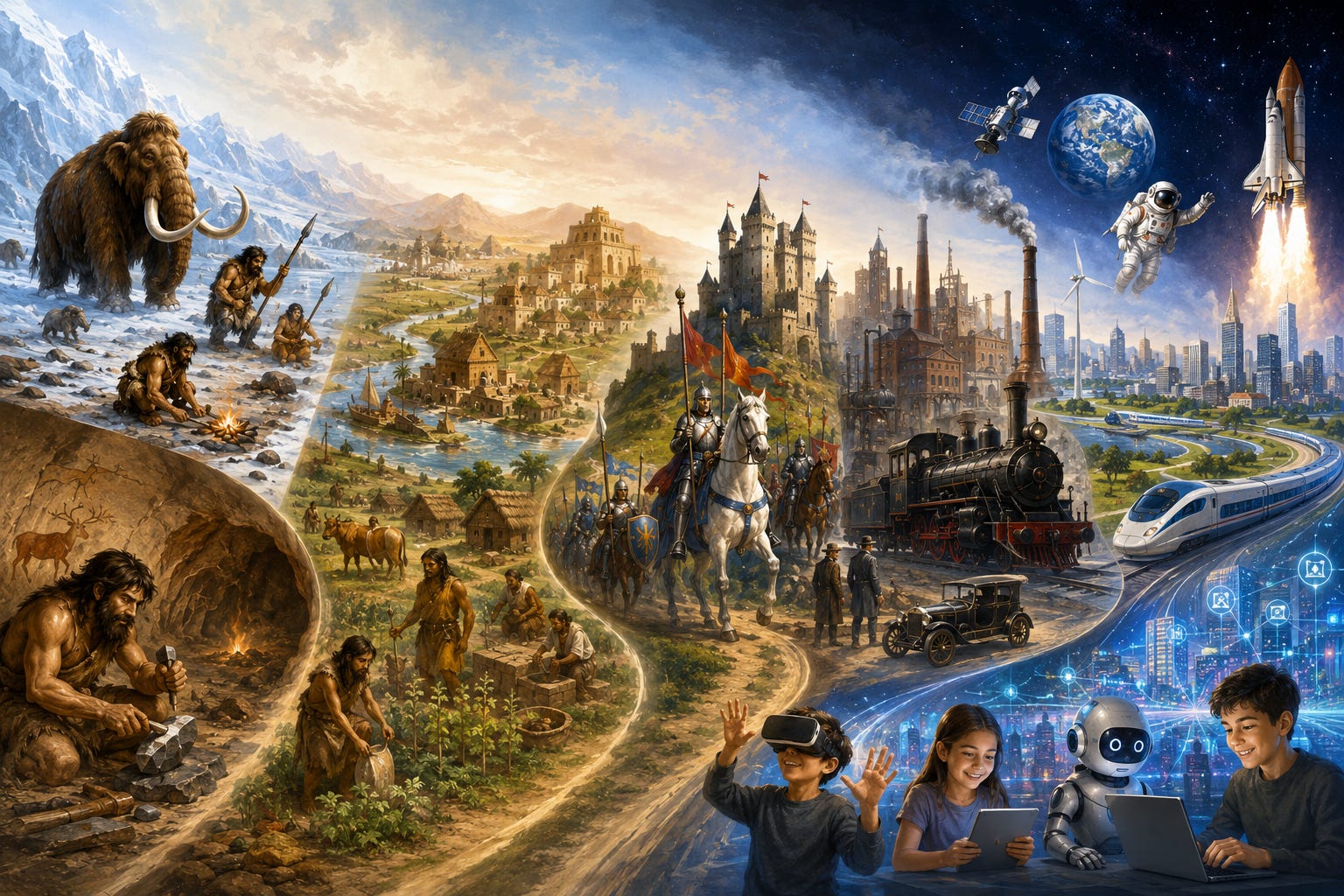
Our planet has changed many times over millions of years. Humans have also discovered new tools, built great civilizations, and created incredible inventions. Historians divide these important periods into different “ages.” Each age tells a unique story about how Earth and people evolved over time.
Let’s travel through some of the most fascinating ages in history!
The Ice Age – When Earth Was Covered in Ice
The Ice Age was a very cold period in Earth’s history when giant sheets of ice covered large parts of the planet. Temperatures were much lower than they are today.
During this time, enormous animals such as woolly mammoths, saber-toothed cats, and giant sloths lived on Earth. Early humans survived by hunting animals, making fires, and wearing warm animal skins.
Life was difficult, but humans learned important survival skills that helped them adapt to harsh conditions.
Fun Fact:
Some glaciers during the Ice Age were several kilometers thick!
The Stone Age – The Beginning of Human Civilization
The Stone Age was the earliest period of human history. People used stones to make tools, weapons, and everyday items.
Early humans lived in caves or simple shelters and spent most of their time hunting, fishing, and gathering food. They also discovered how to control fire, which helped them cook food and stay warm.
Later in the Stone Age, humans began farming and domesticating animals. This was a major step toward building villages and communities.
Fun Fact:
Many Stone Age cave paintings can still be seen today in different parts of the world.
The Bronze Age – The Rise of Cities and Trade
People eventually learned how to melt and mix metals to create bronze, a stronger material than stone.
Bronze tools and weapons improved farming, construction, and transportation. During this age, many early civilizations grew, and trade between cities became more common.
People also developed writing systems, making it easier to record information and share ideas.
Fun Fact:
Bronze is made by combining copper and tin.
The Iron Age – Stronger Tools, Greater Kingdoms
The discovery of iron changed human civilization once again. Iron was stronger and more widely available than bronze, allowing people to create better tools and weapons.
Farming became more efficient, populations grew, and powerful kingdoms emerged across many regions of the world.
The Iron Age helped shape many ancient cultures and civilizations that we still study today.
The Middle Ages – Castles, Kings, and Knights
The Middle Ages began after ancient civilizations declined. During this period, castles, kingdoms, and knights became common.
Most people lived in small villages and worked as farmers. Large stone castles were built to protect rulers and their people from attacks.
This age also saw the construction of magnificent churches, important scientific discoveries, and the growth of universities.
Fun Fact:
Knights trained for many years to become skilled warriors.
The Industrial Age – The Power of Machines
The Industrial Age brought major changes to the way people worked and lived. Machines replaced many forms of manual labor, and factories began producing goods much faster than before.
Steam engines powered trains and ships, making travel and trade easier. Cities expanded rapidly as more people moved to urban areas for work.
This period transformed transportation, communication, and manufacturing across the world.
The Space Age – Exploring Beyond Earth
The Space Age began when humans started exploring outer space using rockets and satellites.
Scientists and astronauts achieved incredible milestones, including landing humans on the Moon. Space exploration helped people learn more about planets, stars, and the universe.
Modern technology such as GPS, weather satellites, and space telescopes grew from discoveries made during this age.
Fun Fact:
The first person to walk on the Moon was Neil Armstrong in 1969.
The Digital Age – The Modern World of Technology
Today, we live in the Digital Age, where computers, smartphones, and the internet connect people around the world instantly.
Technology has changed education, entertainment, communication, and science. Artificial intelligence, robotics, and advanced computers continue to shape the future.
The Digital Age is still evolving, and future generations may experience even more amazing inventions.
Conclusion
From frozen Ice Age landscapes to modern digital technology, every age has helped shape the world we know today. Human history is a story of survival, discovery, creativity, and progress.
As technology continues to advance, one question remains:
What will the next great age be?