

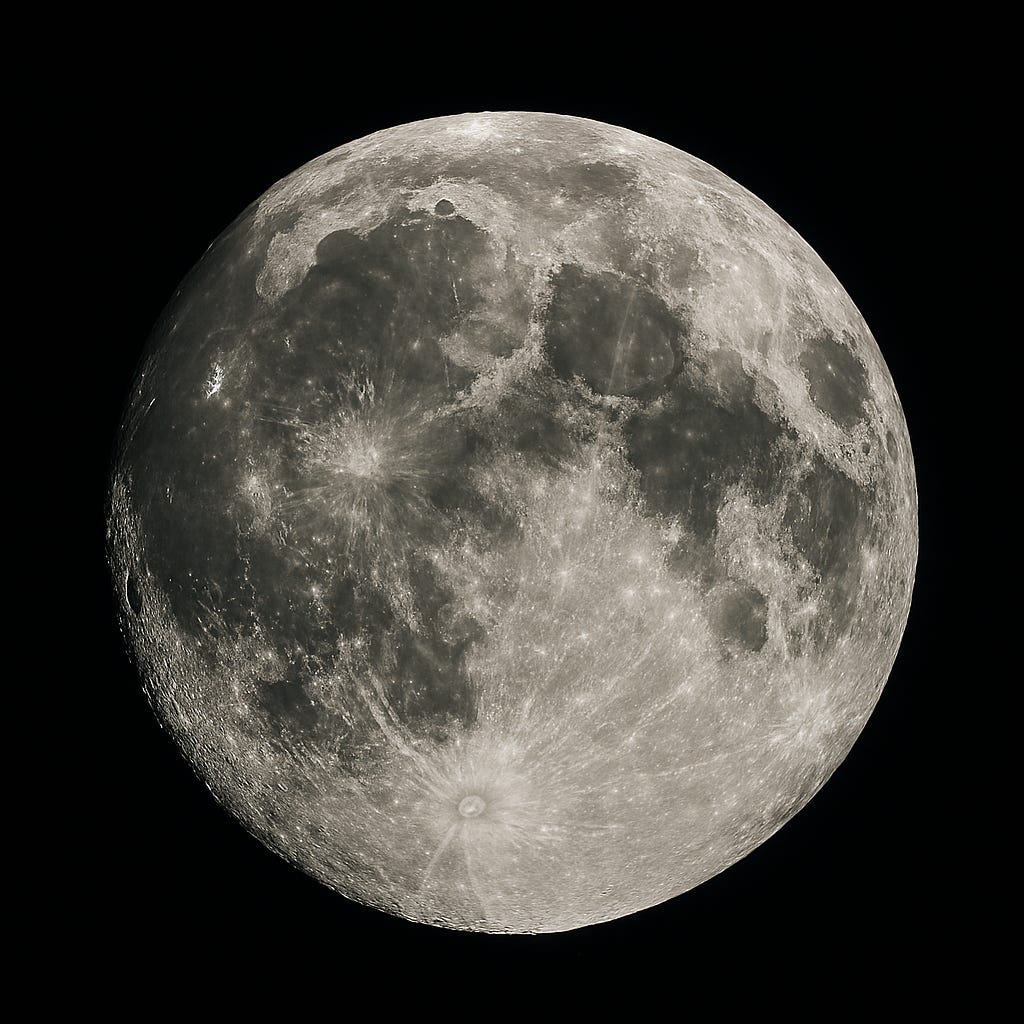
When you look up at the night sky, the brightest object you often see is the Moon. It may look small and calm, but it is a fascinating world in space!
The Moon is Earth’s only natural satellite. It travels around Earth in an oval-shaped path called an orbit. The average distance between Earth and the Moon is about 384,400 kilometers. Even rockets take about three days to reach it!
The Moon is about one-fourth the size of Earth. If Earth were the size of a big basketball, the Moon would be about the size of a tennis ball.
Why Does the Moon Change Shape?
Have you noticed that the Moon looks different on different nights? Sometimes it is a thin curve, sometimes half, and sometimes fully round.
These shapes are called the phases of the Moon. The main phases include:
🌑 New Moon – We cannot see it clearly.
🌒 Waxing Crescent – A small curved shape appears.
🌓 First Quarter – Half of the Moon is visible.
🌔 Waxing Gibbous – More than half is visible.
🌕 Full Moon – The Moon looks completely round.
🌖 Waning Gibbous
🌗 Last Quarter
🌘 Waning Crescent
The Moon does not make its own light. It shines because it reflects sunlight. As the Moon moves around Earth, we see different parts of the side lit by the Sun.
The Moon and Ocean Tides
The Moon has gravity, just like Earth. Its gravity pulls on Earth’s oceans and causes tides.
When the Moon pulls water toward it, we get high tide. In other places, water moves away, causing low tide.
Without the Moon, ocean tides would be much weaker, and this could affect sea animals and even weather patterns.
What Is the Moon Like?
Its surface is covered with dust, rocks, mountains, and large holes called craters. These craters were formed when space rocks called meteoroids crashed into it.
Since there is no wind on the Moon, footprints left by astronauts are still there today!
The Moon has very extreme temperatures. It can be extremely hot during the day and freezing cold at night.
Humans on the Moon
In 1969, astronauts from NASA made history during the Apollo 11 mission.
The first human to step on the Moon was Neil Armstrong. Soon after him, Buzz Aldrin also walked on the Moon.
They collected rocks, conducted experiments, and planted a flag. It was one of the greatest achievements in human history!
The Moon has many fun and interesting facts! Did you know that the same side of the Moon always faces Earth? This means we never get to see the other side from our planet. The Moon also experiences small shakes called “moonquakes.” It takes about 27 days for the Moon to complete one orbit around Earth. Even more amazing, the Moon is slowly moving a little farther away from Earth every year!
The Moon in Stories and Culture
The Moon has inspired stories, poems, and festivals around the world. Many cultures celebrate special full moon nights. It has always been a symbol of beauty, mystery, and wonder.
The next time you see the Moon shining in the sky, remember — it is not just a bright circle. It is a world full of history, science, and amazing discoveries!