

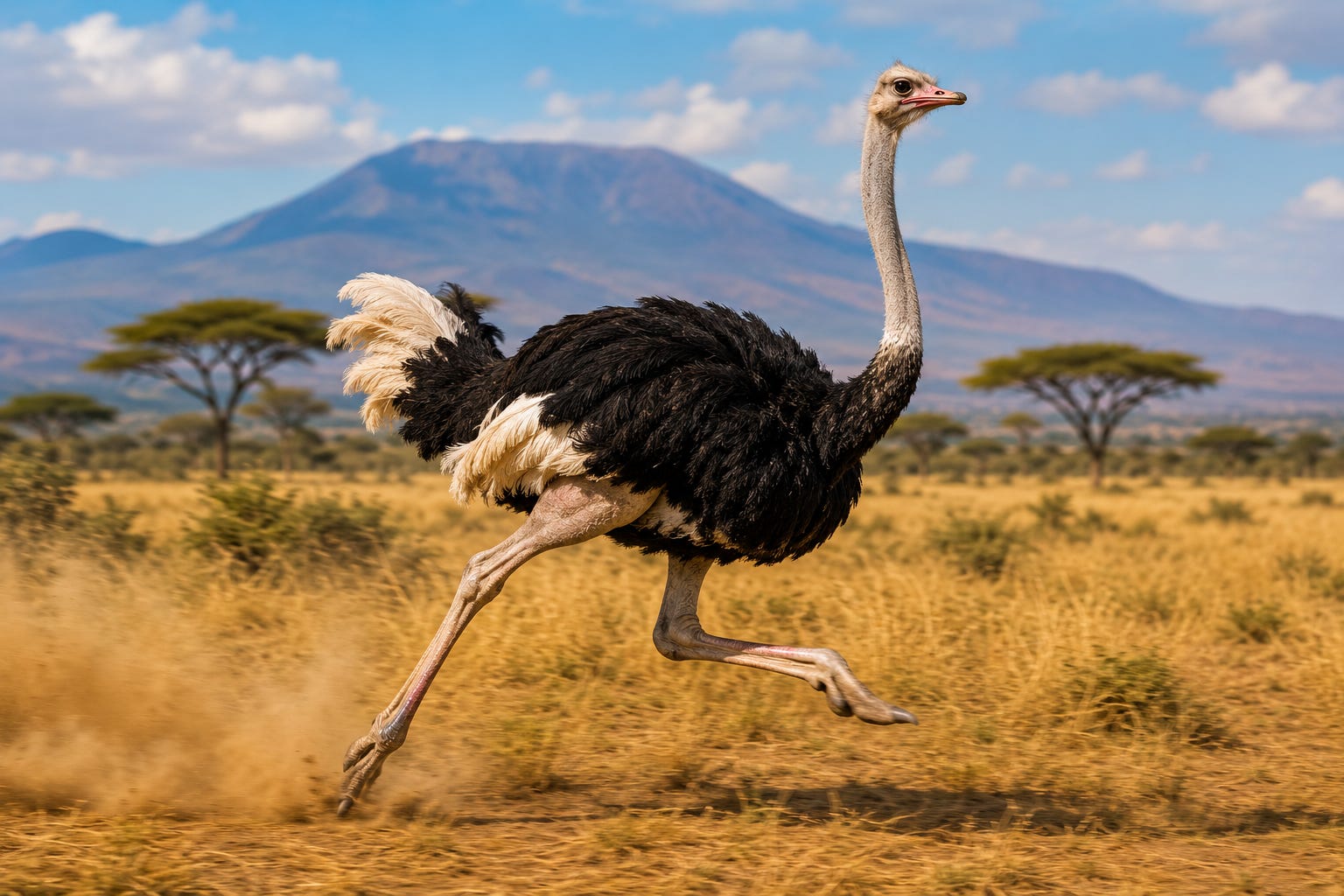
Have you ever seen a bird taller than most grown-ups? Or a bird that can run faster than many cars drive through city streets? Meet the ostrich—the biggest bird on Earth and one of nature’s most amazing runners!
At first glance, an ostrich may look a little funny with its long neck, tiny head, fluffy feathers, and long legs. But don’t let its unusual appearance fool you. This giant bird is perfectly designed for life on the open African grasslands. Instead of flying through the sky, it races across the land at incredible speeds, escaping danger with its powerful legs.
Let’s discover why the ostrich is one of the most fascinating birds in the world!
A Bird Unlike Any Other
Most birds use their wings to fly, but the ostrich has chosen a different superpower—speed!
Although ostriches have large wings, they are simply too heavy to lift off the ground. An adult ostrich can grow up to 2.7 metres (9 feet) tall and weigh as much as 150 kilograms (330 pounds). That’s heavier than many adults!
Instead of flying, nature gave the ostrich something even more impressive: long, muscular legs that can carry it across the savanna at speeds of 70 kilometres (43 miles) per hour. That makes it the fastest-running bird on Earth.
Home on the African Savanna
Ostriches live in the wide-open grasslands, savannas, and semi-deserts of Africa. These places have very few trees, allowing the birds to see for miles in every direction.
Living in open spaces is a clever survival strategy. When danger approaches, an ostrich usually spots it long before the predator gets close. Rather than hiding, it simply runs away at top speed!
These vast grasslands are also home to zebras, giraffes, elephants, antelopes, and lions, making the ostrich part of one of the world’s most exciting wildlife communities.
Built for Running, Not Flying
Everything about an ostrich’s body is made for running.
Its long legs act like powerful springs, helping it take giant steps that can stretch over 5 metres (16 feet) in a single stride. Its strong thigh muscles provide amazing power, while its wings spread out like balancing poles whenever it makes sharp turns.
Even its feet are special. Most birds have three or four toes, but an ostrich has only two. This unique foot design helps it run faster and more efficiently, almost like wearing built-in running shoes!
Those Enormous Eyes!
One of the ostrich’s most surprising features is its eyes.
Each eye is about 5 centimetres (2 inches) across—making them larger than its own brain! These huge eyes help the bird spot predators from far away, giving it plenty of time to escape.
Long eyelashes protect the eyes from blowing sand and dust, which is especially useful in the dry African climate.
What’s on the Menu?
Ostriches aren’t picky eaters.
They enjoy a mixture of grasses, leaves, flowers, seeds, berries, and fruits. They also snack on insects, lizards, and other tiny animals whenever they get the chance.
Since ostriches don’t have teeth, they swallow small stones called gastroliths. These stones stay inside the bird’s stomach and help grind up food, much like our teeth do for us.
Nature always finds clever solutions!
Giant Eggs for a Giant Bird
If the ostrich is the world’s largest bird, it’s no surprise that it also lays the world’s largest eggs.
A single ostrich egg can weigh around 1.5 kilograms (3 pounds)—about the same as 20 to 24 chicken eggs combined!
Female ostriches often lay their eggs together in one large nest dug into the ground. Both parents take turns guarding the eggs from hungry predators. After about 42 days, the chicks hatch and are ready to walk almost immediately.
Baby ostriches may look tiny beside their parents, but they grow incredibly fast and can become almost as tall as adults within a year.
Can an Ostrich Protect Itself?
Absolutely!
Although ostriches usually choose to run away from danger, they can defend themselves if they have to.
Their long legs are incredibly powerful, and a single kick can scare away—or even seriously injure—predators like lions or hyenas. Their sharp claws add extra strength to each kick.
Because of this, even powerful predators think twice before attacking an adult ostrich.
Do Ostriches Really Bury Their Heads in the Sand?
You’ve probably heard this famous story—but it’s actually a myth!
Ostriches never bury their heads in the sand to hide from danger.
Sometimes they lower their heads close to the ground while turning their eggs or checking their nests. From far away, it looks like their head has disappeared underground, which is probably how this myth began.
So the next time someone says an ostrich hides by burying its head, you’ll know the real story!
Amazing Ostrich Facts
The ostrich is the largest living bird on Earth.
It is the fastest-running bird in the world.
Its eyes are bigger than its brain.
It has only two toes on each foot.
It can survive for several days without drinking water because it gets moisture from the plants it eats.
Its wings help it balance while running, even though they cannot be used for flying.
Baby ostriches can run only a few days after hatching!
The ostrich may never soar through the clouds, but it doesn’t need to. With its giant size, powerful legs, enormous eyes, and record-breaking speed, it has become one of the most extraordinary birds on our planet.
Nature reminds us that everyone has different strengths. While some birds rule the skies, the ostrich is the undisputed champion of the land—proving that you don’t need to fly to be truly amazing!
Free The Ostrich - Worksheet
Want to help your child remember what they learned?
I’ve created a free printable The Ostrich Worksheet filled with fun activities, matching exercises, and drawing challenges.

🖨️ Print it at home for a screen-free learning activity.
📄 Download the PDF and let your child complete it at their own pace.
I’d love to see your child’s finished worksheet! Feel free to share a photo in the comments or tag us on social media.