

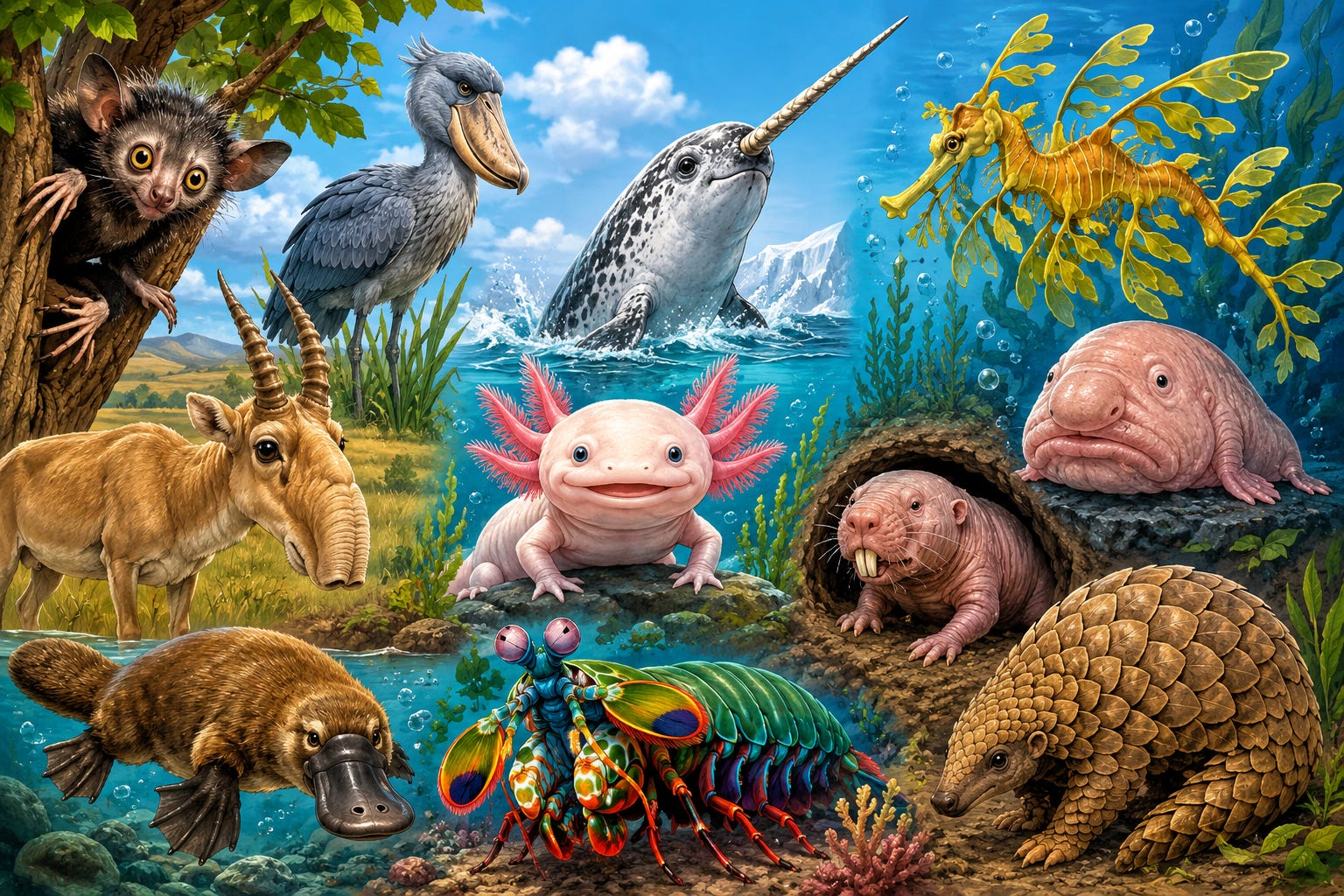
Have you ever seen an animal and thought, “Wait… is that real?”
Our planet is filled with millions of amazing animals, and some of them look so unusual that they seem to have jumped straight out of a science-fiction movie! From animals with extra-long noses to creatures that can regrow body parts, nature has some wonderfully weird surprises.
But remember—weird doesn’t mean bad! These unusual features often help animals find food, stay safe, survive harsh environments, or communicate with one another.
So grab your imaginary explorer’s hat and get ready to meet some of Nature’s Weirdest Creatures!
1. The Axolotl: The Animal That Can Regrow Body Parts
The axolotl looks like it is always wearing a happy little smile! This unusual amphibian comes from Mexico and spends its life in water.
What makes the axolotl especially amazing is its ability to regrow parts of its body. It can regenerate limbs and can even repair parts of some organs and tissues.
Unlike most amphibians, axolotls usually keep their juvenile features even when they become adults. Their feathery gills stick out from the sides of their heads, helping them breathe underwater.
Talk about having a superpower!
2. The Star-Nosed Mole: A Nose Like No Other
Imagine having a nose with 22 tiny finger-like tentacles around it. That’s exactly what the star-nosed mole has!
This strange-looking animal lives in wet areas of North America. Its unusual nose is incredibly sensitive and helps it explore its surroundings and locate food.
The tentacles aren’t there to make the mole look funny—they are actually useful sensory organs. The mole can use them to investigate objects and detect prey.
Its strange nose is a perfect example of how nature designs animals for their environment.
3. The Aye-Aye: The Long-Fingered Lemur
With huge eyes, big ears, shaggy fur, and an extra-long middle finger, the aye-aye certainly looks unusual!
This nocturnal lemur lives in Madagascar. It uses its long finger to help find food hidden inside trees.
The aye-aye taps on branches and listens for clues that something tasty might be hiding underneath the bark. Once it finds a good spot, it uses its teeth to open the wood and then reaches inside with its long finger.
It’s like having a built-in tree detective tool!
4. The Leafy Sea Dragon: A Fish That Looks Like Seaweed
If you were swimming in the ocean and spotted a leafy sea dragon, you might think you had found a piece of seaweed!
This fascinating Australian fish has leaf-like extensions covering its body. These don’t work like ordinary fins for swimming. Instead, they help the animal blend into its surroundings.
This is called camouflage.
By looking like floating seaweed, the leafy sea dragon can make itself harder for predators to spot. It also helps it sneak up on tiny prey.
Nature’s hide-and-seek champion!
5. The Shoebill: The Bird With a Giant Bill
The shoebill is a huge African bird with an enormous bill that looks a little like a wooden shoe. That’s where its name comes from!
Its giant bill is perfectly suited for catching prey in the wetlands where it lives. Shoebills can hunt fish and other aquatic animals.
They are also famous for standing incredibly still while waiting for the right moment to strike.
With its tall body, giant bill, and intense stare, the shoebill looks like it belongs in a prehistoric adventure!
6. The Saiga Antelope: The Antelope With a Funny Nose
The saiga antelope has one of the strangest noses in the animal kingdom.
Its large, flexible nose hangs down over its mouth. It may look funny, but it has an important job.
The unusual nose can help filter dust from the air and may help warm cold air before it reaches the animal’s lungs.
Saigas live in the grasslands and semi-deserts of Central Asia, where dusty winds and extreme temperatures can make life challenging.
So that funny-looking nose is actually a clever survival tool!
7. The Narwhal: The Unicorn of the Sea
Meet the animal often called the unicorn of the sea!
The narwhal is a type of whale that lives in Arctic waters. Many male narwhals—and some females—have a long tusk that grows from a tooth.
The tusk can reach several metres in length!
For a long time, people wondered what the tusk was used for. Scientists now know that it contains millions of nerve endings and may help narwhals sense changes in their environment. Narwhals may also use their tusks during social interactions.
Imagine seeing one swimming through the icy Arctic!
8. The Platypus: A Mammal Full of Surprises
The platypus seems like nature mixed several animals together!
It has a bill like a duck, a tail like a beaver, and webbed feet. But here’s the really surprising part: the platypus is a mammal that lays eggs.
It lives in freshwater environments in Australia.
Platypuses also have another unusual ability. Male platypuses have venomous spurs on their hind legs that can deliver a painful sting.
If you were designing an animal for a fantasy story, the platypus might seem too strange to be believable!
9. The Pangolin: The Mammal Covered in Scales
Most mammals have fur, but the pangolin is different. Its body is covered in hard protective scales made from keratin—the same material found in our hair and fingernails.
When threatened, a pangolin can curl itself into a tight ball, using its scales as armor.
Pangolins have long, sticky tongues that help them eat ants and termites. They don’t have many teeth, so their tongue does much of the hard work!
Sadly, pangolins are threatened by illegal hunting and trafficking. Protecting these unusual animals is an important part of protecting Earth’s biodiversity.
10. The Mantis Shrimp: The Tiny Creature With Amazing Eyes
Don’t let the small size fool you—the mantis shrimp is one seriously fascinating ocean creature!
Some species have incredibly complex eyes that can detect types of light that humans cannot see. Their eyes can also move independently.
And then there’s their famous punch.
Certain mantis shrimp can strike with their club-like appendages at astonishing speeds. Their strikes are powerful enough to break the shells of prey.
It may be small, but this colorful crustacean is packed with incredible abilities!
11. The Blobfish: Not Always as Blobby as It Looks
The blobfish has become famous for its unusual, droopy appearance. But there’s an important secret behind that funny face.
Blobfish live deep in the ocean, where the pressure is extremely high. Their bodies are adapted to those deep-sea conditions.
When a blobfish is brought rapidly to the surface, the sudden change in pressure can dramatically change its appearance.
So the blobfish may not actually look like the famous “sad blob” picture when it is happily living in its deep-sea home!
12. The Naked Mole Rat: A Very Different Mammal
The naked mole rat has almost no hair, large front teeth, and wrinkly skin. It may not win a beauty contest, but it has some fascinating abilities!
These animals live underground in colonies in parts of East Africa. Their large front teeth help them dig tunnels and find food.
Unlike most mammals, naked mole rats live in a social system somewhat like that of bees or ants, with one breeding female and many workers.
They are a wonderful reminder that every animal has its own special way of surviving.
Why Does Nature Make Animals So Weird?
Looking at all these creatures, you might wonder: Why are animals so strange?
The answer is evolution.
Over many generations, animals develop features that can help them survive in their particular environments. A long finger can help an aye-aye find food. A powerful bill can help a shoebill catch prey. Protective scales can help a pangolin defend itself. Leaf-like body parts can help a sea dragon hide.
What looks strange to us may be perfectly useful to the animal.
Nature doesn’t follow a single design. It experiments with shapes, colours, sizes, behaviours, and abilities—and the result is an incredible variety of life.
Weird Can Be Wonderful!
From an axolotl that can regenerate body parts to a narwhal with a unicorn-like tusk, Earth’s animals are full of surprises.
And here’s the best part: we haven’t discovered everything yet!
Scientists continue to explore forests, oceans, caves, deserts, and even the deepest parts of our planet. Who knows what unusual creatures might still be waiting to be discovered?
So the next time you see an animal that looks a little strange, don’t laugh and call it weird.
Take a closer look. That unusual feature might just be one of nature’s most brilliant inventions! 🌎🐾