

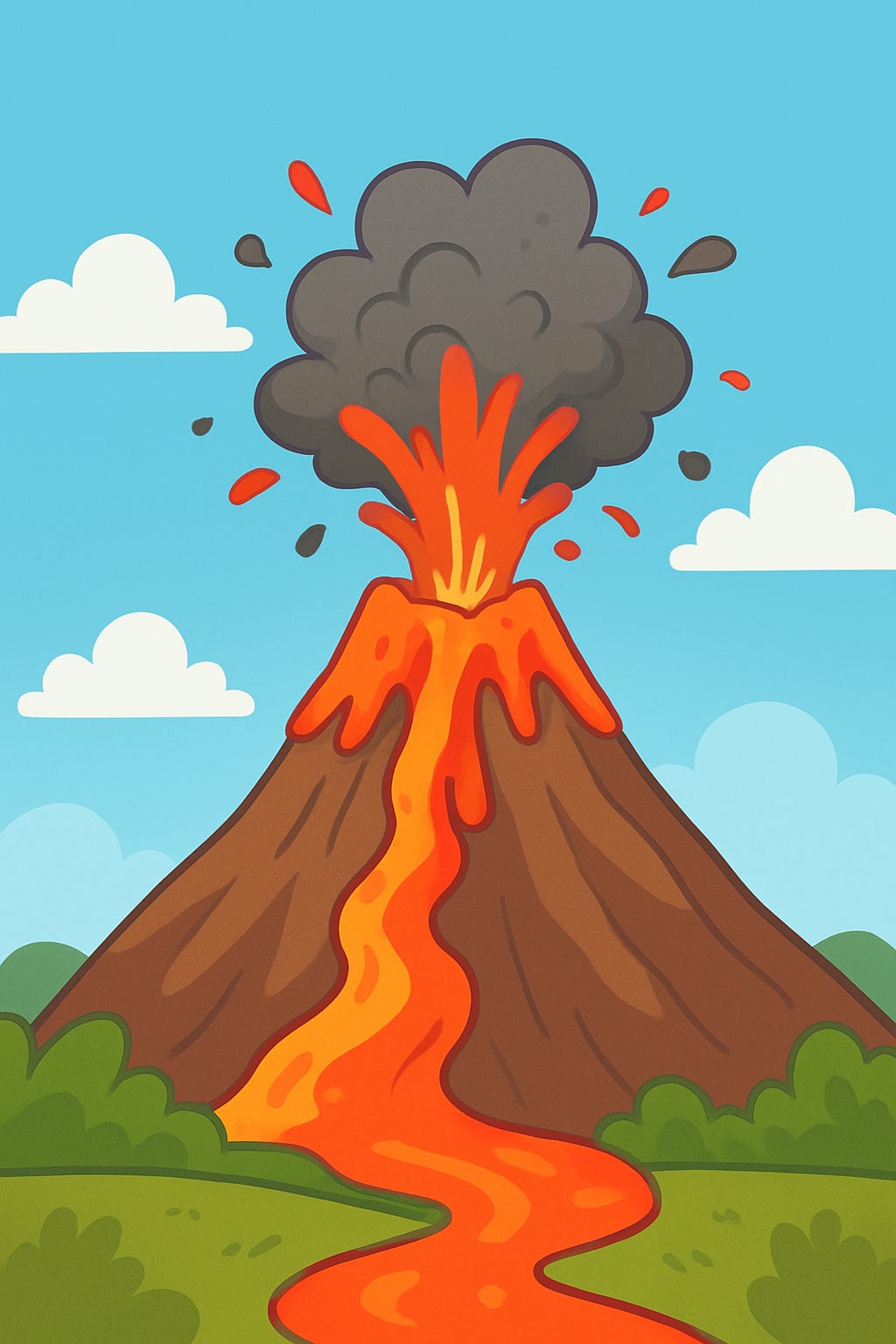
A volcano is a special kind of mountain that has a deep opening inside the Earth. Under the ground, it’s so hot that rocks melt and become magma—a thick, hot liquid. When magma pushes upward and comes out of the volcano, it’s called lava. This is what we see during an eruption!
How Does a Volcano Erupt?
1. Deep Inside the Earth – It’s Extremely Hot
Far below the ground, the Earth’s temperature is so high that solid rocks melt.
This melted rock is called magma.
It collects in a big underground pool called a magma chamber.
2. Pressure Starts to Build Up
As more magma gathers inside the magma chamber, it creates a lot of pressure, just like shaking a soda bottle.
The hotter the magma gets, the more it expands and pushes upward.
3. Magma Finds a Way Out
The Earth’s surface has cracks and weak spots.
When the pressure becomes too strong, the magma forces its way through these cracks.
These cracks form a vent — a passage that leads toward the top of the volcano.
4. Boom! The Volcano Erupts
When the pressure gets too high, the volcano can no longer hold it.
So, it erupts, pushing magma, hot gases, and ash out of the vent.
During an eruption, several things can come out:
Lava – red-hot liquid rock that flows down the mountain
Ash – tiny pieces of rock that rise like a dark cloud
Gas – steam and other gases that shoot out forcefully
Volcanic bombs – big chunks of rock thrown high into the air
5. After the Eruption – A New Layer Forms
When the lava cools down, it becomes solid rock.
Each time a volcano erupts, it adds a new layer of rock.
This is how volcanoes grow bigger over time.
6. The Cycle Continues
After an eruption, the volcano can:
Calm down for a while
Erupt again soon
Or stay quiet for hundreds of years
This is why volcanoes can be active, dormant, or extinct.
Types of Volcanoes Based on Activity
Active Volcano
An active volcano is awake. It has erupted recently or shows signs that it might erupt again.
Example: Mount Etna in Italy.
Dormant Volcano
A dormant volcano is asleep. It hasn’t erupted for a long time, but it could erupt again someday.
Example: Mount Fuji in Japan.
Extinct Volcano
An extinct volcano is dead. It hasn’t erupted for thousands of years and is not expected to erupt again.
Example: Shiprock in the USA.
Effects of Volcanic Eruptions
Volcanoes can be powerful and dangerous, and they cause many changes to the environment, animals, and people.
1. Lava Flow
When lava flows down the volcano, it can burn everything in its path—trees, plants, roads, and even houses.
2. Ash Clouds
Volcanoes release huge clouds of ash (tiny pieces of rock).
Ash can:
Cover buildings and cars
Make the air hard to breathe
Block sunlight and make the sky dark
3. Pyroclastic Flows
These are extremely fast, hot clouds of ash and gas.
They move like a super-hot avalanche and can cause severe damage.
4. Earthquakes
Volcanoes often come with small earthquakes as magma pushes upward.
5. Changes in Land
Volcanoes can create new land when lava cools and becomes rock.
Islands like Hawaii were formed this way!
Safety Measures & Precautions During a Volcano Eruption
Here are the important safety steps people should follow to stay safe:
1. Follow Warnings
Scientists and officials give warnings when a volcano might erupt.
Always listen to alerts and follow instructions.
2. Evacuate When Told
If authorities ask people to leave the area, they should evacuate immediately.
3. Wear Masks and Goggles
Ash in the air can hurt your lungs and eyes.
Wearing a mask and goggles can protect you.
4. Stay Indoors During Ashfall
If ash is falling, stay inside your home.
Close windows and doors to keep ash out.
There are more than 1,500 active volcanoes on Earth, and some of them are even found deep underwater. But the biggest volcano of all isn’t on our planet—it’s on Mars! Called Olympus Mons, this giant volcano is the largest in our entire solar system.