

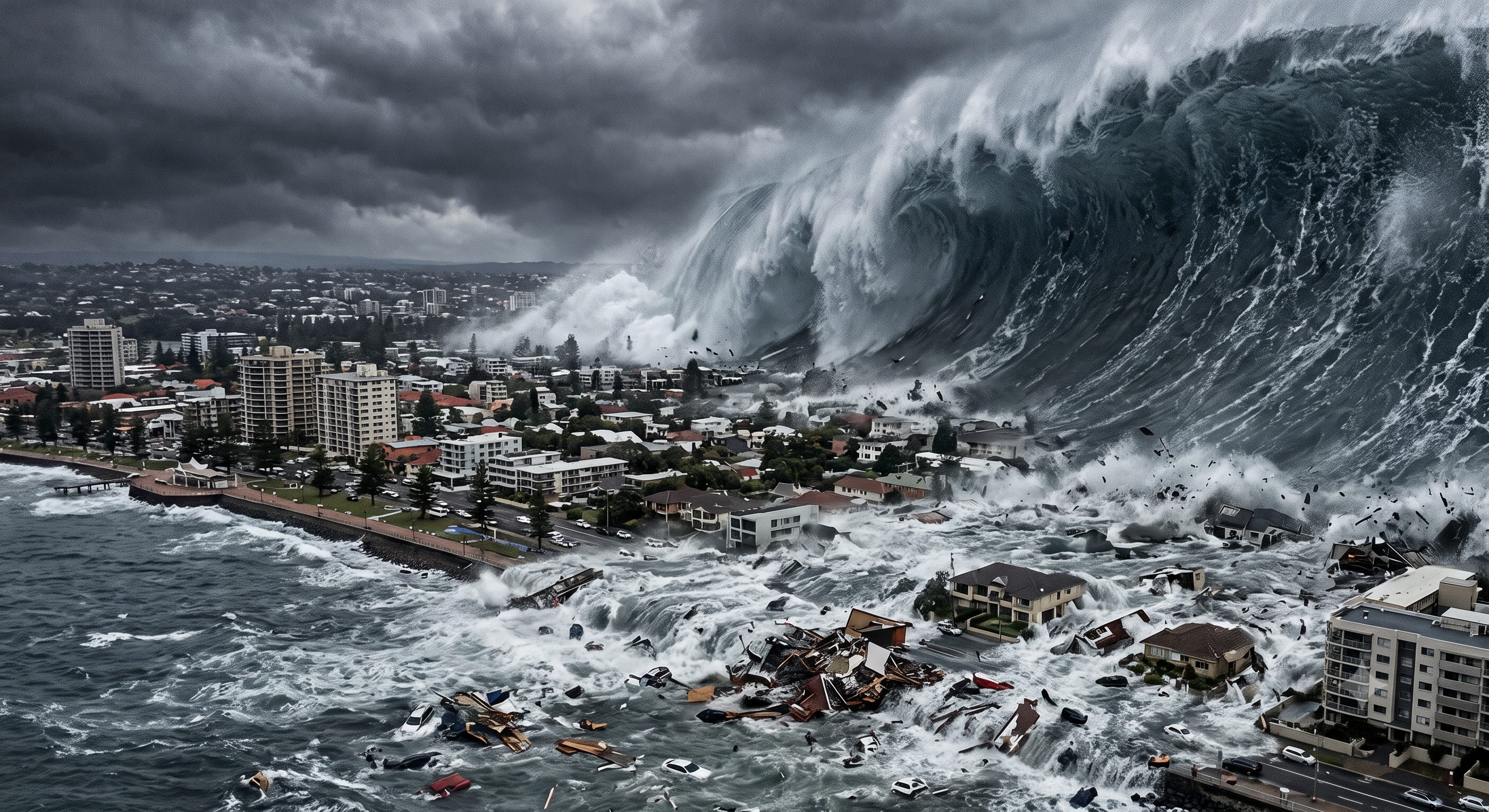
Imagine you’re building a sandcastle on the beach. The waves are gently rolling in, and everything seems peaceful. Suddenly, the ocean begins to pull back much farther than usual. Fish are left flopping on the wet sand, and boats are resting on the exposed seafloor.
At first, it might seem exciting—but it’s actually one of nature’s biggest warning signs.
Just a few minutes later, a giant wall of water races toward the shore. This is a tsunami, one of the most powerful forces on Earth.
A tsunami (soo-NAH-mee) is not just one giant wave—it's a series of powerful waves that travel across the ocean at incredible speeds. In deep water, these waves may only be about a meter high, making them difficult for ships to notice. As they approach shallow coastal waters, they slow down, grow much taller, and can cause severe flooding.
Where Do Tsunamis Happen?
Tsunamis can happen almost anywhere there is an ocean, but they are most common around the Pacific Ocean.
This area is called the Ring of Fire because it has many earthquakes and volcanoes. Countries such as Japan, Indonesia, Chile, New Zealand, the Philippines, and the west coast of North and South America experience more tsunamis than most other places.
Even the Indian Ocean has experienced devastating tsunamis, such as the one in 2004.
Can a Tsunami Cross an Entire Ocean?
Yes!
A tsunami can travel across the entire Pacific Ocean in less than a day.
For example, an earthquake near Japan can create tsunami waves that eventually reach the west coast of North America, even though the countries are thousands of kilometres apart.
That’s why scientists around the world work together to monitor earthquakes and warn coastal communities.
How Do Scientists Detect Tsunamis?
Today, scientists use amazing technology to detect tsunamis before they reach land.
They use:
Earthquake-monitoring stations
Deep-ocean pressure sensors
Satellites
Coastal warning systems
Emergency alerts on television, radio, and mobile phones
These systems give people valuable time to move to safer places.
What Should You Do During a Tsunami?
Knowing what to do can save lives.
If you’re near the coast:
Stay calm.
If you feel a strong earthquake, don’t wait for an official warning.
Move immediately to higher ground.
Follow evacuation signs.
Stay away from beaches, rivers, and harbours.
Wait until authorities say it is safe before returning.
Remember:
Don’t stop to watch the waves. A tsunami is much stronger and faster than it looks.
Famous Tsunamis in History
🇮🇩 Indian Ocean Tsunami (2004)
Triggered by one of the strongest earthquakes ever recorded.
Affected 14 countries.
Waves reached heights of over 30 metres in some places.
More than 230,000 people lost their lives.
It led to the creation of better tsunami warning systems.
🇯🇵 Japan Tsunami (2011)
Caused by a magnitude 9.0 earthquake.
Produced waves over 40 metres high in some areas.
Damaged the Fukushima nuclear power plant.
Scientists learned even more about preparing for future tsunamis.
Why Don’t Ships Notice Tsunamis in Deep Water?
This surprises many people!
In the deep ocean, a tsunami may be only about 1 metre high, but it can stretch for hundreds of kilometres from one wave crest to the next.
Ships simply rise and fall gently as the wave passes underneath.
The real danger begins only when the wave reaches shallow water near the coast.
Amazing Tsunami Facts
A tsunami is a series of waves, not just one.
It can travel as fast as 800 km/h (500 mph).
Some tsunamis have crossed entire oceans.
Deep-sea animals often don’t notice them.
Large ships are usually safer in deep water than near the shore.
The first wave isn’t always the biggest.
Tsunami waves may continue arriving for several hours.
Did You Know?
The energy inside a tsunami is so powerful that it can move giant ships, uproot trees, destroy buildings, and even reshape coastlines. Yet in the middle of the ocean, it may look like nothing more than a gentle swell!
Free Tsunami - Worksheet
Want to help your child remember what they learned?
I’ve created a free printable Worksheet filled with fun activities, matching exercises, and drawing challenges.

🖨️ Print it at home for a screen-free learning activity.
📄 Download the PDF and let your child complete it at their own pace.
I’d love to see your child’s finished worksheet! Feel free to share a photo in the comments or tag us on social media.