

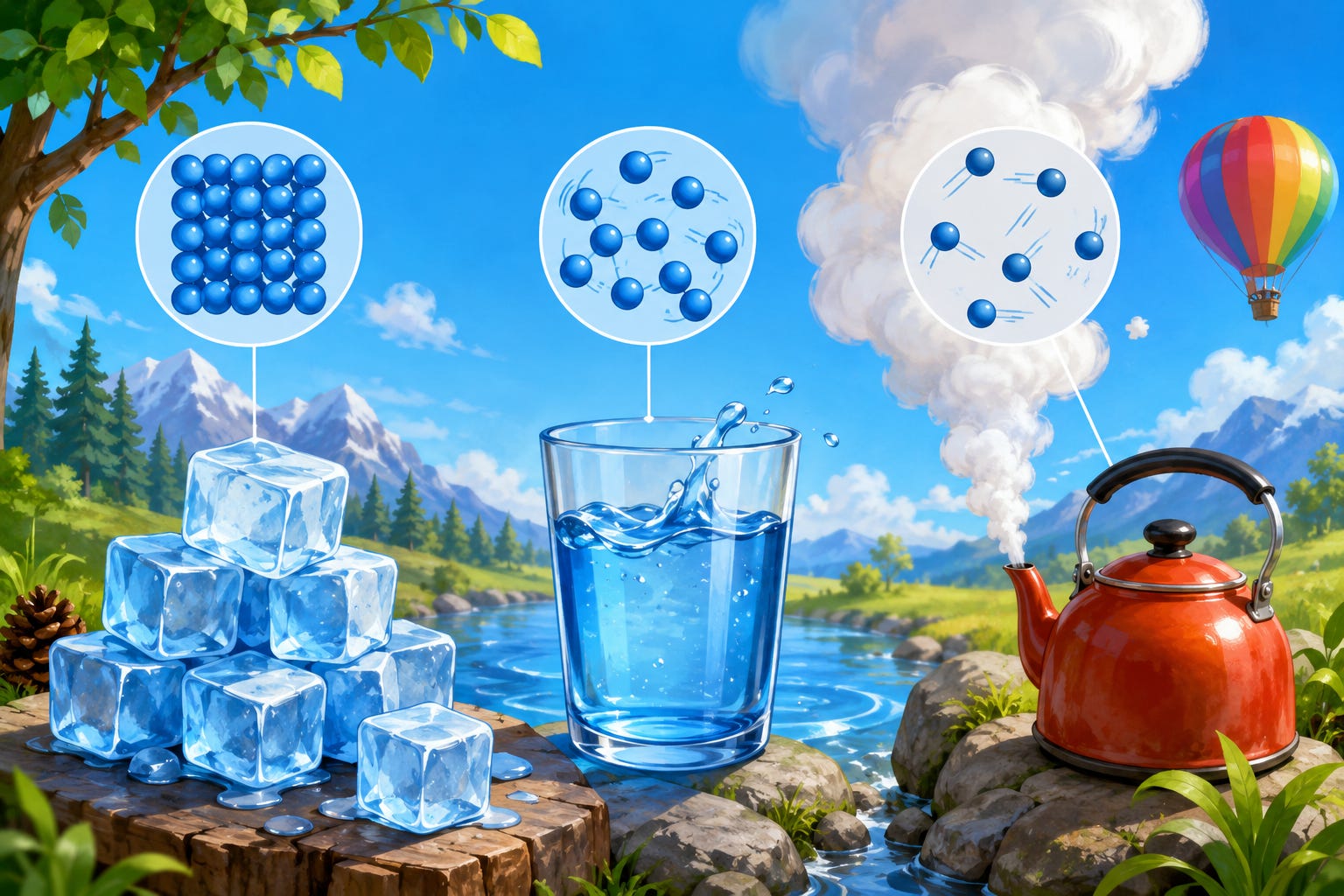
Have you ever wondered why an ice cube keeps its shape, while water takes the shape of a glass? Or how water can disappear into the air when you boil it?
The answer lies in something called matter!
Matter is all around us. Your pencil, your breakfast, your favorite toy, the air you breathe, and even the water in your bottle are all made of matter. Matter can be found in three common forms, or states: solid, liquid, and gas.
Let’s put on our scientist hats and explore this amazing world!
What Is Matter?
Matter is anything that takes up space and has mass.
That might sound like a big science sentence, but it is actually quite simple.
Think about your school bag. It takes up space, and it has weight because it contains matter. The water in your bottle takes up space too. Even the air inside a balloon is matter!
Matter is made up of tiny building blocks called particles. These particles are far too small for us to see with our eyes.
The way these tiny particles are arranged and how they move helps determine whether something is a solid, liquid, or gas.
1. Solids: Strong and Steady!
A solid has a definite shape and a definite amount of space, called its volume.
Look around you. A book, a pencil, a chair, a toy car, and an apple are all solids.
What makes solids special?
The tiny particles in a solid are packed closely together. They cannot move around freely. Instead, they mostly vibrate in place.
Imagine a classroom full of children standing shoulder-to-shoulder in their places. They don’t have much room to move around. That is a little like the particles in a solid!
Because the particles stay closely packed, a solid keeps its own shape.
Try This!
Put a pencil on a table. It stays the same shape.
Now put it inside a box. It is still a pencil and still has the same shape.
That is because a solid does not simply change shape to fit its container.
Examples of solids
Ice, Books, Stones, Wooden blocks, Spoons, Toys, Fruits, Coins etc..
Fun fact: Some solids can be very hard, while others can be soft. A diamond is extremely hard, while a sponge is soft. Both are solids!
2. Liquids: Flowing Everywhere!
Now let’s move on to liquids.
A liquid has a definite volume but does not have a definite shape. It takes the shape of the container holding it.
Water is probably the liquid you know best. But milk, juice, cooking oil, and honey are liquids too.
The particles in a liquid are still fairly close together, but they have more freedom to move than particles in a solid.
Imagine children in a playground. They are close enough to see each other, but they can move around, walk, and change places. That’s a bit like particles in a liquid!
This ability to move allows liquids to flow.
Try This!
Pour some water into a glass.
It takes the shape of the glass.
Now pour the same water into a bowl.
The water spreads out and takes the shape of the bowl.
Did the water change its amount?
No!
It changed its shape, but its volume stayed the same.
Examples of liquids
Water, Milk, Juice, Honey, Oil, Shampoo, Paint etc..
Fun fact: Water is one of the most important liquids on Earth. Plants, animals, and humans all need water to survive.
3. Gases: Invisible Explorers!
The third common state of matter is gas.
Unlike solids and liquids, gases do not have a definite shape or a definite volume. They spread out and fill the space available to them.
You might think, “But I can’t see air, so how can it be matter?”
Good question!
Although most gases are invisible, you can see what they do.
Think about a balloon. When you blow air into it, the balloon expands. The air takes up space inside the balloon.
You can also feel air when you run outside on a windy day. Air may be invisible, but it is definitely there!
Gas particles are much farther apart than particles in solids and liquids. They move quickly and in many directions.
Imagine children running around a huge playground. They have lots of space and can move freely. That’s similar to how particles behave in a gas.
Examples of gases
Oxygen, Carbon dioxide, Water vapor, Nitrogen, Helium etc..
Fun fact: The air around us is actually a mixture of several different gases. Nitrogen and oxygen make up most of Earth’s atmosphere.
Matter Can Change!
Here’s where things get really exciting.
Matter can change from one state to another.
Think about an ice cube.
Ice is solid water. Leave it somewhere warm, and it begins to melt.
Melting
When a solid gains enough heat, it can change into a liquid.
Ice → Water
This change is called melting.
Now imagine heating that water on a stove.
Eventually, the water begins to boil and changes into water vapor, a gas.
Water → Water vapor
This change is called evaporation when liquid changes into gas from its surface, and boiling when the liquid changes rapidly throughout the liquid at its boiling point.
But the changes don’t only happen in one direction!
If water vapor cools down, it can turn back into liquid water.
Condensation
Water vapor → Water
This is called condensation.
Have you ever noticed tiny drops of water on the outside of a cold glass?
Those drops don’t usually come from the water inside the glass. Water vapor in the surrounding air cools when it touches the cold surface and changes into liquid water.
Amazing, right?
Freezing
If liquid water gets cold enough, it can become solid ice.
Water → Ice
This change is called freezing.
So water can travel through different states:
Solid → Liquid → Gas
And it can also travel back:
Gas → Liquid → Solid
What About Steam?
People often use the word “steam” to describe the gas produced when water is heated.
But here’s a cool science detail: water vapor itself is invisible.
The white cloud you see above a boiling pot is made largely of tiny liquid water droplets that form as the hot water vapor cools in the surrounding air.
So the next time you see a white cloud rising from a hot cup or pot, you are witnessing water changing and moving through different states!
Can You Spot the Changes?
Nature is constantly showing us changes in states of matter.
The water cycle is a fantastic example. You can read full article on water cycle here:
What Is the Water Cycle? 🌍💧

Have you ever wondered how the water we drink, bathe in, and see in oceans and rivers keeps moving around the Earth? The answer lies in the water cycle, nature's incredible way of recycling water! In this blog, we'll break it down step-by-step in a way that's easy and fun to understand.
Try This Simple Experiment
The Melting Race
You will need:
Two small ice cubes
Two plates
A sunny or warm place
A cool place
Place one ice cube on each plate.
Put one plate somewhere warm and the other somewhere cooler.
Watch what happens.
Which ice cube melts faster?
The warmer surroundings give the ice more heat, causing it to melt faster.
Remember: Ask an adult for help if you are doing experiments near heat or hot objects.
Matter Matters!
From the ice in your lemonade to the air filling your lungs, matter is part of everything around you.
Solids give us objects we can hold. Liquids flow from one place to another. Gases fill the air around us. And with changes in temperature, matter can transform from one state to another.
So the next time you see an ice cube melting, water boiling, or droplets forming on a cold window, stop for a moment and think:
What’s happening to the tiny particles?
You have just uncovered one of the wonderful secrets of science!
Free States of matter Worksheet
Want to help your child remember what they learned?
I’ve created a free printable States of matter Worksheet filled with fun activities, matching exercises, and drawing challenges.

🖨️ Print it at home for a screen-free learning activity.
📄 Download the PDF and let your child complete it at their own pace.
I’d love to see your child’s finished worksheet! Feel free to share a photo in the comments or tag us on social media.