

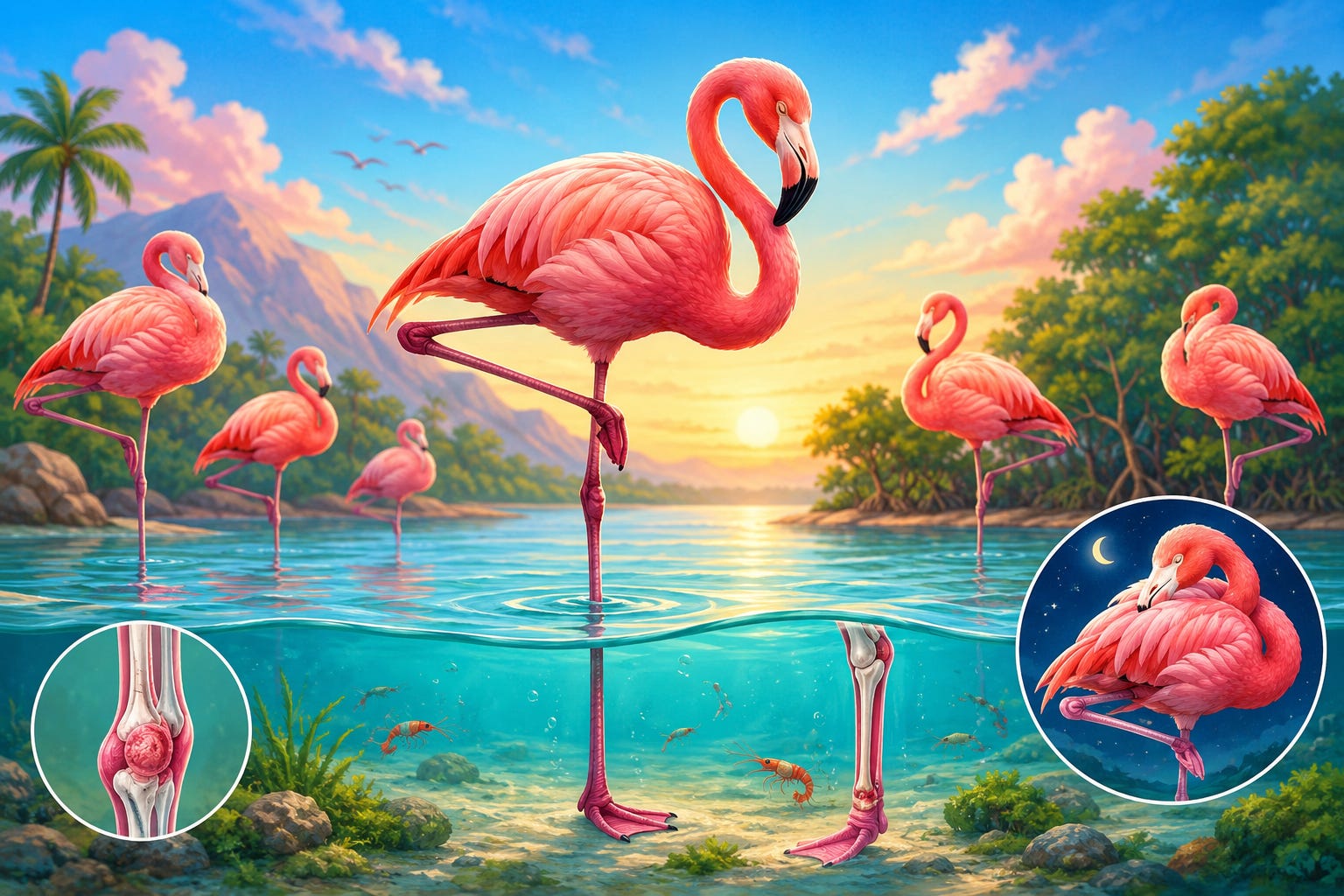
Have you ever seen a flamingo standing perfectly still on one long, skinny leg and wondered, “How does it do that?”
Flamingos are famous for their bright pink feathers, long legs, and funny-looking beaks. But one of their most amazing tricks is their ability to stand on one leg for a surprisingly long time.
Is it because they are practicing yoga? Or are they simply showing off?
There is actually a clever scientific reason behind this unusual pose!
The One-Legged Mystery
Flamingos spend a lot of time standing in shallow water, where they search for food such as algae, tiny crustaceans, and other small creatures.
When they rest, they often lift one leg and tuck it close to their body.
Scientists believe that standing on one leg helps flamingos save energy. It may seem harder to balance on one leg, but a flamingo’s body is specially designed to make this position surprisingly easy.
A Body Built for Balance
A flamingo’s legs look very long and thin, but they are strong.
Their joints and muscles work together to support their body while they stand. When a flamingo places one foot underneath its body, its leg can lock into a stable position.
This means the flamingo doesn’t have to constantly use its muscles to keep itself upright.
Think of it like standing a stick upright on its end. If everything is lined up correctly, the stick can stay balanced without much effort.
A flamingo uses a similar trick with its body!
Why Stand on One Leg While Resting?
One important reason may be energy conservation.
Keeping both legs working all the time can use more muscle energy. By resting one leg while standing on the other, a flamingo can give the lifted leg a break.
After some time, it can simply switch legs.
Scientists have also found that flamingos can even sleep while standing on one leg!
Imagine being able to take a nap without sitting or lying down!
Keeping Warm
There may be another useful reason for the one-legged pose: keeping warm.
Flamingos often live in places where the water can be quite cold. Their long legs are exposed to the surrounding water and air, so pulling one leg close to their warm body may help reduce heat loss.
It’s a bit like putting one hand inside your pocket when you’re outside on a chilly day.
Scientists are still studying exactly how much the one-legged position helps flamingos control their body temperature, but it is likely to be one of several benefits.
Flamingos Can Switch Legs
Do flamingos always use the same leg?
No!
A flamingo can switch from one leg to the other when it wants to.
It might stand on its left leg for a while, then lower it and lift its right leg.
And here’s something fun: young flamingos have to learn how to balance, just like young children learning new physical skills.
It takes practice to become a one-legged balancing expert!
Is It Really Comfortable?
It might look uncomfortable to us, but flamingos have a body structure that makes the position much easier for them.
Their legs are not shaped quite the way they appear.
What looks like a backward-bending knee is actually largely the flamingo’s ankle joint. Their real knees are higher up and are usually hidden beneath their feathers.
This unusual leg structure helps give flamingos their distinctive appearance.
So when you see a flamingo standing on one leg, remember that you’re looking at a very clever piece of natural engineering!
Why Don’t They Fall Over?
You might think a strong breeze or a little splash would make a flamingo tumble into the water.
But flamingos are excellent balancers!
Their long necks and bodies help them maintain their balance, while their feet provide a stable base.
They can also quickly put their second leg down if they need extra support.
And if a flamingo does lose its balance?
Splash!
Luckily, it is usually standing in water, so there’s no need for a soft landing pad.
Flamingo Fun Facts
Here are some fun facts about these amazing birds:
Flamingos are born with gray or whitish feathers, not bright pink ones.
Their pink color comes mainly from pigments called carotenoids found in their food.
Flamingos have long legs that help them wade through shallow water.
Their unusual beaks are specially shaped for filter-feeding.
A group of flamingos is called a flamboyance. What a fabulous name!
Flamingos can rest and even sleep while standing on one leg.
Different flamingo species live in parts of Africa, Asia, Europe, North America, South America, and the Caribbean.
Free Flamingo Worksheet
Want to help your child remember what they learned?
I’ve created a free printable Flamingo Worksheet filled with fun activities, matching exercises, and drawing challenges.

🖨️ Print it at home for a screen-free learning activity.
📄 Download the PDF and let your child complete it at their own pace.
I’d love to see your child’s finished worksheet! Feel free to share a photo in the comments or tag us on social media.