

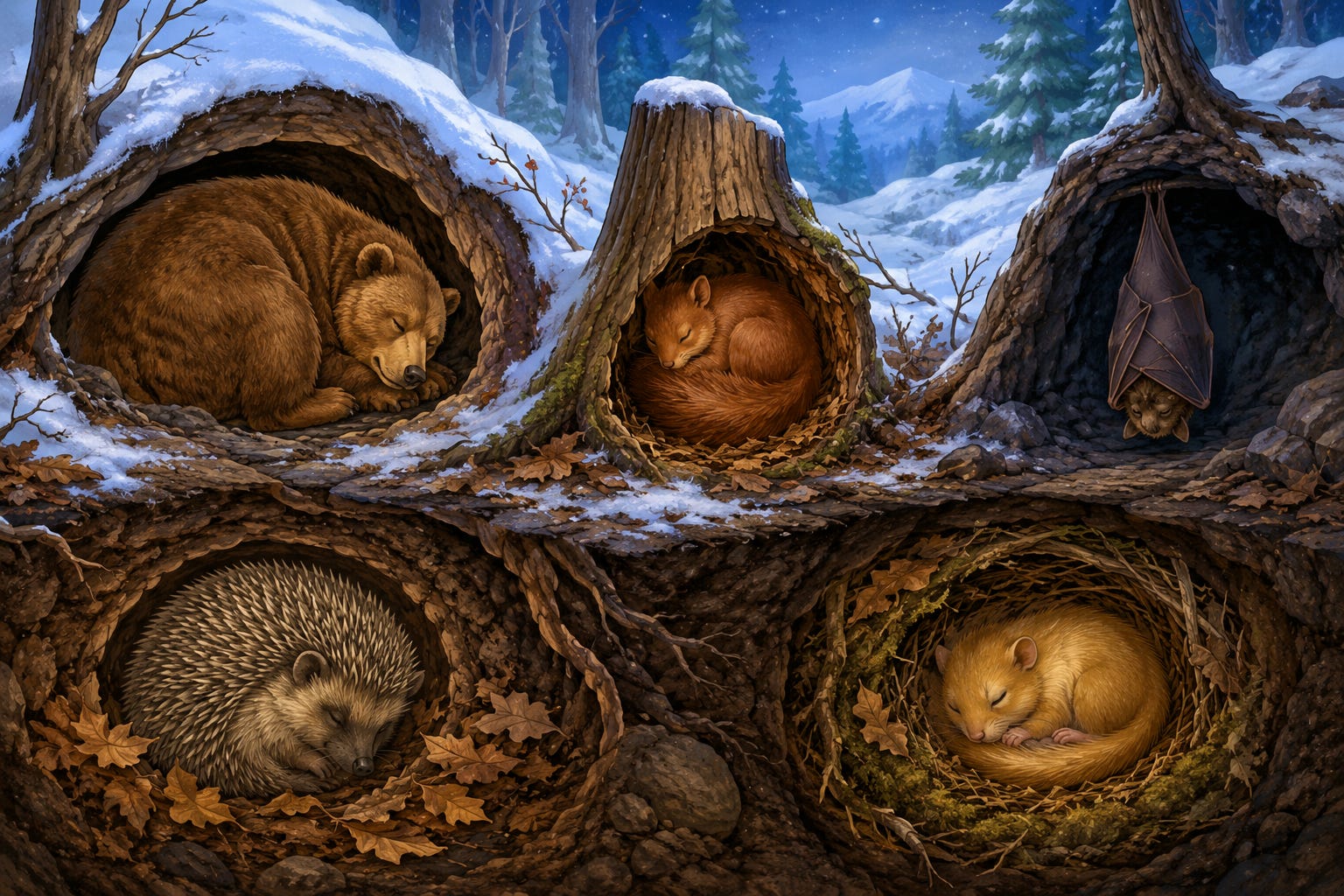
Imagine crawling into a cozy bed as winter arrives, snuggling under a warm blanket, and not having to get up for weeks or even months! Sounds wonderful, right?
Well, some animals do something surprisingly similar. When cold weather arrives and food becomes difficult to find, certain animals enter a special state called hibernation.
What Is Hibernation?
Hibernation is a special state in which an animal’s body becomes much less active for a period of time.
During hibernation, several things happen:
The animal’s body temperature drops.
Its heartbeat becomes much slower.
It breathes much more slowly.
It uses much less energy.
It becomes very inactive.
Instead of spending lots of energy searching for food and staying warm, the animal slows its body down and lives mostly on energy stored in its body.
Think of it as putting the body into energy-saving mode!
Why Do Animals Hibernate?
Winter can be a difficult season for animals.
In many places, temperatures become extremely cold. Plants stop growing, insects disappear, and other sources of food become difficult to find. Snow and ice can make searching for food even harder.
For a small animal that needs to eat frequently, this can be a serious problem.
Hibernation provides a clever solution.
Before winter arrives, some animals eat plenty of food and build up fat reserves. When they enter hibernation, their bodies use this stored fat as fuel.
Instead of going out into the cold to search for food, they stay safely tucked away and use their stored energy.
What Happens Inside a Hibernating Animal?
A hibernating animal may look as though it is simply sleeping, but its body is doing something extraordinary.
Its heartbeat can slow dramatically. Its breathing becomes very slow, and its body temperature can fall.
For example, a ground squirrel may have a body temperature only a few degrees above freezing during deep hibernation!
The animal’s metabolism—the process by which the body uses energy—also slows down.
This means the animal needs far less food and oxygen than it would when awake.
It’s almost as though the animal has pressed a pause button on many of its body functions while keeping the important ones going.
Which Animals Hibernate?
Several different animals use hibernation or forms of winter dormancy to survive challenging conditions.
🐿️ Ground Squirrels
Ground squirrels are famous hibernators. They spend much of the warmer months eating and storing energy in the form of body fat.
When winter arrives, they retreat to underground burrows and enter deep hibernation.
Their body temperature and heartbeat can drop dramatically.
🦇 Bats
Some bats hibernate during winter.
They often gather in cool, sheltered places such as caves, where temperatures remain relatively stable. They may hang quietly for long periods while using very little energy.
If they stayed active throughout a freezing winter when insects were scarce, finding enough food could be extremely difficult.
🦔 Hedgehogs
Hedgehogs in colder regions may enter hibernation during winter.
They curl into a tight ball and settle into a sheltered nest. Their body temperature, heartbeat, and breathing slow down while they conserve energy.
When warmer weather returns and food becomes available again, they become active.
🐹 Dormice
Dormice are tiny mammals that can spend several months in hibernation.
Before winter, they eat a lot and build up fat reserves. Then they settle into nests and conserve their energy until conditions improve.
Do Bears Really Hibernate?
Here’s where things get interesting!
People often say that bears hibernate, and bears certainly enter a long period of winter dormancy. But bear hibernation is different from the deep hibernation seen in animals such as ground squirrels.
A bear’s body temperature does not fall nearly as dramatically. Bears can also wake up and move around during their winter rest.
Female bears may even give birth to cubs while inside their winter den!
So while “bear hibernation” is commonly used, scientists sometimes describe the bear’s winter state as a different form of dormancy.
How Do Animals Prepare for Hibernation?
Animals don’t simply decide one morning, “Winter is coming. Time for bed!”
Their bodies respond to changes in the environment, such as shorter days and cooler temperatures.
Many animals prepare months in advance.
They may:
Eat more food:
Animals such as ground squirrels build up fat reserves before hibernation.
Find a safe shelter:
They may choose burrows, caves, hollow logs, or nests that protect them from extreme weather and predators.
Reduce their activity:
As winter approaches, their bodies gradually prepare to slow down.
By the time winter arrives, they are ready for their long period of rest.
Hibernation Isn’t Just for Winter!
Although we usually think of hibernation as a winter survival strategy, animals can also enter similar states during other difficult periods.
Some animals enter aestivation, a period of dormancy that helps them survive extremely hot or dry conditions.
For example, certain animals become inactive during very hot, dry weather when water and food are difficult to find.
So animals have more than one clever way to slow down and conserve energy when their environment becomes challenging.
Nature’s Amazing Energy-Saving Trick
Hibernation is one of nature’s cleverest survival strategies.
Instead of fighting against freezing temperatures and a shortage of food, animals such as ground squirrels, bats, hedgehogs, and dormice slow their bodies down and conserve precious energy.
They prepare carefully, find a safe place to rest, and rely on stored energy until better conditions return.
So the next time you see a picture of an animal curled up in a cozy winter hideaway, remember: it isn’t simply sleeping—it’s using an amazing survival trick that has helped animals survive challenging seasons for thousands of years!
🌟 Think Like a Scientist!
Imagine you are a small animal living in a place where winter lasts for several months.
What would you do to prepare for winter?
Would you collect food? Build a cozy shelter? Grow thicker fur? Or perhaps find a safe place to hibernate?
Nature has given every animal its own fascinating way to survive!
Free Hibernation Worksheet
Want to help your child remember what they learned?
I’ve created a free printable Hibernation Worksheet filled with fun activities, matching exercises, and drawing challenges.

🖨️ Print it at home for a screen-free learning activity.
📄 Download the PDF and let your child complete it at their own pace.
Don’t forget to follow us ChatteringChipmunks . Do like, share and subscribe.