

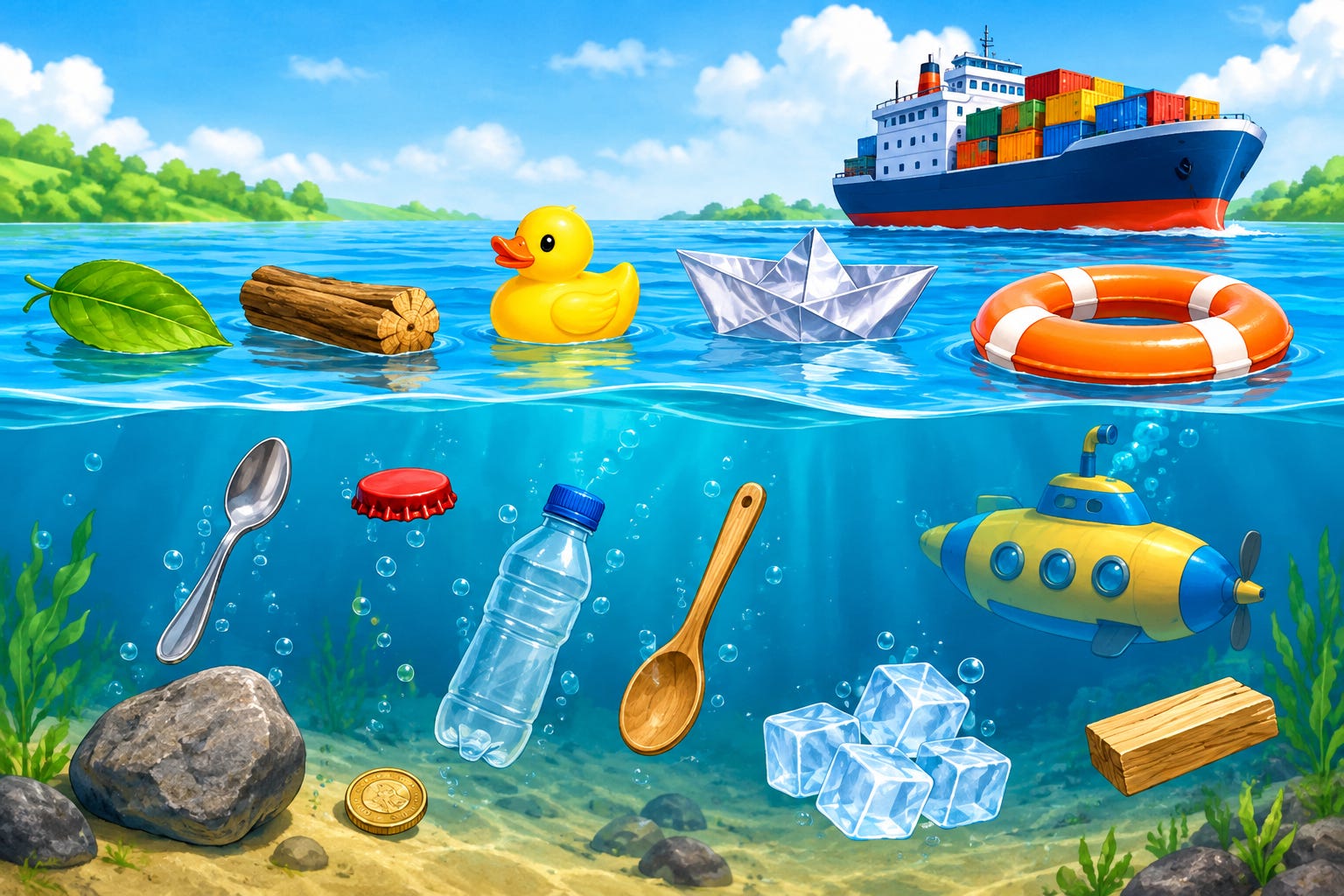
Have you ever dropped a pebble into a pond and watched it disappear under the water? But then you put a leaf on the water, and it stays happily on the surface!
Why does this happen?
Why does a heavy rock sink while a huge ship, carrying thousands of kilograms of cargo, can float?
The answer has to do with density, water, and a special pushing force called buoyancy. Don’t worry—these words sound complicated, but the idea is actually quite simple!
Let’s dive in and discover the science behind sinking and floating!
What Does It Mean to Sink or Float?
When you place an object in water, one of two things usually happens.
If the object moves downward and goes under the water, we say it sinks.
If the object stays on the surface, we say it floats.
Some objects can even do something in between. A submarine, for example, can move up and down in the water by changing how much water is inside its special tanks.
But what decides whether something sinks or floats?
The secret is density.
What Is Density?
Density tells us how much matter is packed into a certain amount of space.
Imagine two boxes that are exactly the same size. One is filled with feathers and the other is filled with stones.
The boxes take up the same amount of space, but the box full of stones is much heavier because more matter is packed into it.
The stones have a greater density than the feathers.
In simple words:
More matter packed into the same space = greater density.
Water also has a density. An object that is less dense than water can float, while an object that is more dense than water usually sinks.
Why Does a Rock Sink?
Take a small rock and drop it into a glass of water.
Plop!
Down it goes.
A rock is made of tightly packed materials, so its density is usually greater than the density of water. Because of this, the rock cannot stay supported by the water and sinks.
Even though the rock may be small, it can still be denser than a much larger object.
That’s an important clue:
Size alone does not decide whether something floats or sinks.
Then How Can a Huge Ship Float?
This is where things get really interesting!
A ship can be enormous and weigh thousands of tonnes, yet it floats on water.
How?
Look carefully at the shape of a ship. It isn’t a giant solid block of metal. Instead, it has a large, hollow shape filled mostly with air.
The ship spreads its weight over a large volume. This makes the average density of the whole ship—including the air inside it—low enough for it to float.
The water pushes upward on the ship. This upward push is called buoyancy.
When the upward force from the water is strong enough to balance the ship’s weight, the ship floats.
So, a metal ship doesn’t float because metal is less dense than water. Metal is actually denser than water.
It floats because of its hollow shape and the large amount of water it displaces.
Meet Buoyancy!
Imagine trying to push a beach ball underwater.
What happens?
As soon as you let go, the ball shoots back toward the surface!
That’s because water pushes upward on objects placed in it. This upward force is called buoyant force, or simply buoyancy.
The deeper you push the ball, the more strongly it seems to want to pop back up.
Buoyancy is one of the most important reasons objects can float.
A floating object has found a balance between two forces:
Gravity pulls it downward.
Buoyancy pushes it upward.
When these forces balance, the object stays afloat.
Why Does a Coin Sink but a Boat Float?
Let’s compare a coin and a boat.
A coin is small and made of metal. It is much denser than water, so it sinks.
A boat may also contain metal, but it has a large, hollow shape. This allows it to push aside—or displace—a large amount of water.
The displaced water pushes upward on the boat.
If the upward buoyant force is strong enough to support the boat’s weight, the boat floats.
This is why you can have a tiny metal coin that sinks and a gigantic metal ship that floats!
What Does “Displace Water” Mean?
“Displace” simply means to move something out of the way.
When you climb into a bathtub, the water level rises.
Why?
Because your body takes up space that the water used to occupy. Your body pushes some water out of the way.
You have displaced water!
The same thing happens when a boat enters the water. The boat pushes water aside.
The more water an object needs to displace, the greater the upward buoyant force can be.
What About a Piece of Wood?
Try placing a piece of wood in water.
It will probably float.
Most types of wood are less dense than water, so the water can support them.
In fact, some kinds of wood are so light that they can float very easily.
This is one reason wood has been used to build boats for thousands of years.
What About Ice?
Here’s a cool surprise!
Ice floats on water.
That’s unusual because ice is simply water in a solid form.
When water freezes, its molecules arrange themselves into a structure that takes up more space. As a result, ice becomes less dense than liquid water.
That’s why ice cubes bob around in your drink instead of sinking to the bottom.
This special property of water is also very important in nature.
When lakes freeze, the ice floats on top and can form a layer that helps keep the water underneath from freezing completely.
Does Air Have Anything to Do With Floating?
Absolutely!
Air is much less dense than water.
That’s why objects filled with air can be very buoyant.
Think about an inflatable swimming ring. It may be made from plastic, but it contains a large amount of air.
The air-filled ring takes up a lot of space without adding much weight.
That’s why it can float so easily.
The same basic idea helps enormous ships stay afloat.
What About a Person in Water?
Have you ever noticed that it is easier to float when you take a deep breath?
When you breathe in, your lungs fill with air. This increases the volume of your body without adding much weight.
Your average density becomes a little lower, and your body can receive more support from the water.
That’s one reason swimmers often find it easier to float when they relax and take a deep breath.
Submarines: The Masters of Sinking and Floating!
Submarines have a clever way of controlling their position underwater.
They use special tanks called ballast tanks.
When a submarine wants to dive, it allows water to enter its ballast tanks. This makes the submarine heavier overall, so it moves downward.
When it wants to rise, it pushes water out of the tanks and replaces it with air.
The submarine becomes less dense overall and rises toward the surface.
By carefully controlling the amount of water and air, submarines can move up, down, or stay at a particular depth.
It’s almost like having a built-in floating switch!